
Read this guide in
CHEESECAKE FORMULATION GUIDE
Reduced-sugar cheesecake: compare sweetness, set and water release
Evaluate sweetness, set, slice hold and refrigerated water release separately when choosing a sweetener for a reduced-sugar cheesecake.
For a reduced-sugar cheesecake, write the sample brief around the real product form and keep four decisions separate: sweetness, gel or set formation, slice integrity, and water release during the agreed chilled window. A sample may match sweetness while its body or water balance changes. Approval belongs to the defined formula, process, package and target market.
This guide helps dessert manufacturers and development teams prepare a sweetener inquiry for Hengliyuan. Choose an ingredient or blend direction using the actual cheesecake base and process; retail pack sweetness is not a finished-dessert formulation instruction.
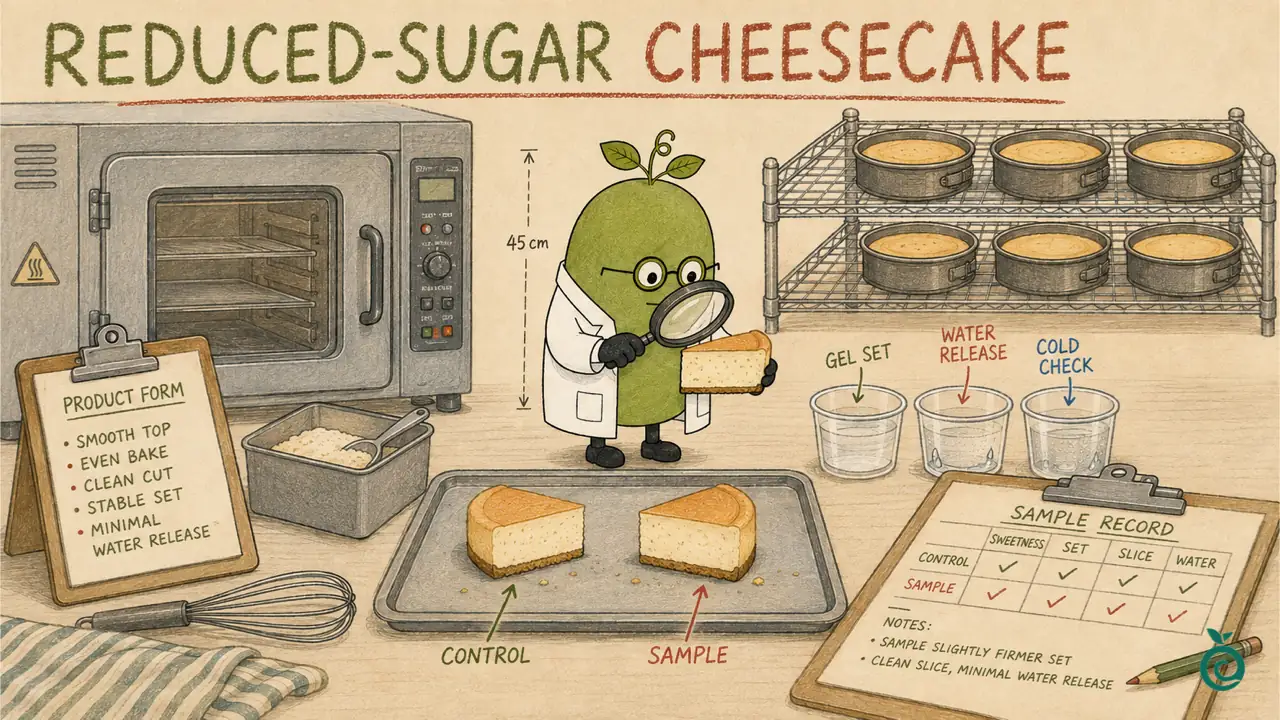
What should be fixed before the first sample?
Start with the product, not the ingredient name. State whether the sample is baked or unbaked, the cheese and cream base, crust or no crust, fruit or chocolate additions, the current or sucrose control, the intended sweetener form and the target market. Add the package, serving condition, storage condition and the one decision the sample must answer. This matters because a baked cheesecake and a cold-set cheesecake do not build structure in the same way. A fruit-topped slice and a plain chilled filling also bring different water and handling questions. If those details are missing, a supplier may send a technically relevant material that answers the wrong question.
Why can sweetness pass while set or slice hold changes?
Sugar contributes more than sweetness in a dessert system. The Food Standards Agency's cheesecake reformulation guidance describes roles involving bulk, mouthfeel, texture and interaction with free water, alongside the sensory effect. Those functions sit next to cream, fat, dairy solids, the crumb and the setting process; they are not automatically replaced by matching sweetness. That is why a brief should not collapse the result into 'tastes right' or 'did not set.' Record the sensory result, the physical set and the slice separately. The open-access cheesecake model study used more than one physical and refrigerated observation in its defined product system. It can support the structure of a test plan, but it does not establish a universal result for all cheesecake formulas or sweetener types.
How should a sample matrix separate the observations?
Keep the current control visible. Use separate rows for sweetness and finish, gel or set, slice integrity, refrigerated water release, and formula or label context. For sweetness, record onset, peak, finish, sourness balance and unwanted aftertaste. For set, record the agreed method, firmness, flow and visible separation. For a slice, record clean cut, edge break, center hold, crust lift and filling movement. For refrigerated water release, record surface water, leakage, syneresis, wet zones and any agreed measurement. For formula and label context, record sweetener identity, form, carrier, label question and document gap. Change one main variable at a time where the project allows it.
How should baked and no-bake routes be handled?
Write the setting route in plain language. For a baked product, record the bake method and cooling sequence used by the project. For a no-bake product, record the cold-set system and the relevant mixing, hydration or chilling steps. If gelatin, starch or another hydrocolloid is present, name it as part of the real formula and test method; do not copy a dose from a different dessert. The related dairy-dessert syneresis literature is useful for choosing observation fields such as gel, firmness and water release. It is not a direct cheesecake recipe. Keep the source model, the actual sample and the decision range for the finished product separate.
What should be checked after chilling?
Use a time ladder that fits the project. Start with the cooled day-zero sample, then repeat the relevant sweetness, set, slice and water-release checks at the agreed refrigerated checkpoints. Keep package, temperature, sample size, opening history and cut method consistent enough to explain a change. A slice that looks clean immediately after chilling does not settle what happens later. Conversely, visible water is an observation, not a diagnosis of the cause or a food-safety conclusion. The package, dairy base, fruit or acid system, process and sweetener form may all deserve review before the next sample is chosen.
How should sweetener form and market review enter the brief?
High-intensity sweeteners and bulk or solids-supporting ingredients can play different roles in a reduced-sugar product. State whether the buyer is asking for concentrated sweetness, added solids, a blend, a powder, a liquid or another format. Do not describe a one-to-one replacement unless the specific formula and test evidence support that wording. Market review belongs in the brief as well. If allulose is part of the project, the FDA's guidance is a U.S. labelling review starting point, not a conclusion for every product or country. China's GB 2760-2024 announcement is an entry point for a China review; the actual food category, ingredient identity, use and finished label still need to be checked for the target market.
Choose which Hengliyuan product direction to discuss
If your team needs a concentrated sweetening ingredient, start with the monk fruit extract specification. If the brief calls for a blend, compare the complete ingredients of the allulose and monk fruit option or the erythritol-based monk fruit series, with or without steviol glycosides. These are product directions to evaluate, not verified cheesecake solutions. Send the current formula context and one unresolved result so the sample request stays specific.
What this guide does not prove
The sources support a structured question list for defined products. They do not provide a fixed cheesecake formula, sweetener replacement percentage, hydrocolloid dose, universal set or syneresis limit, shelf-life result, safety decision, finished-product nutrition claim, global label approval or Hengliyuan performance guarantee. Use the matching product documents, target-market review and real-base testing before commercial decisions.
Technical references and boundaries
Reviewed September 2026 using the Food Standards Agency's cheesecake reformulation guidance, an open-access cheesecake sweetener model study, a related dairy-dessert syneresis study, FDA guidance on allulose labelling and the China GB 2760-2024 entry point. These sources support separating product, sensory, set, slice, water-release and market-review questions. They do not provide a fixed Hengliyuan formula, universal threshold, shelf-life result, safety conclusion or finished-product approval.
Record these fields before comparing cheesecake samples
- Cheesecake form and setting route
- Target market and intended label direction
- Current or sucrose control
- Sweetener identity, form and carrier
- Gel or set observation method
- Slice-integrity observation method
- Refrigerated syneresis or water-release checkpoints
- Packaging specification and storage condition
- One main variable changed
Common questions
Can a sweetener sample that tastes right be approved immediately?
No. Check the defined product's set, slice integrity and refrigerated water release as separate rows, using the same control and agreed conditions.
Is visible water on a chilled cheesecake proof that the sweetener caused the issue?
No. It is a useful observation. Keep the cause open until the base, solids, acid or fruit system, setting process, package and sweetener variables are compared.
Can a baked cheesecake result be reused for a no-bake cheesecake?
Not automatically. The setting route, process history and formula architecture differ, so keep the sample brief and checkpoints tied to the actual product.
Does using allulose or monk fruit make the finished cheesecake low calorie?
No. A finished-product nutrition or label claim depends on the complete formula, serving basis, target market and current verification. The sweetener ingredient name alone is not enough.
What should I send before requesting a cheesecake sample?
Send target market, product type, packaging specification, estimated quantity, required certificates or documents and whether samples are needed. Add the cheesecake form, current control, sweetener form, process, storage condition and the one result the sample must answer.
