Read this guide in
CAKE AND FILLING SCORECARD
Moisture Migration in Filled Cakes: A Buyer Scorecard for Cake and Cream Filling Tests
Compare cake crumb, cream filling and their interface during storage. Use a practical test scorecard for moisture, water activity, texture and packaging.
Test the cake and cream filling as separate materials first, then inspect the assembled product at matched checkpoints. Moisture can move between components, and a filling can change firmness or flow while the cake crumb changes in the opposite direction. One sweetness score or one day-zero bite cannot show that interface.
Use this scorecard for layered cakes, snack cakes, filled sponge cakes, pound-cake sandwiches and similar bakery projects. It is a test record for a defined product and package, not a universal aw target, formula or shelf-life protocol.
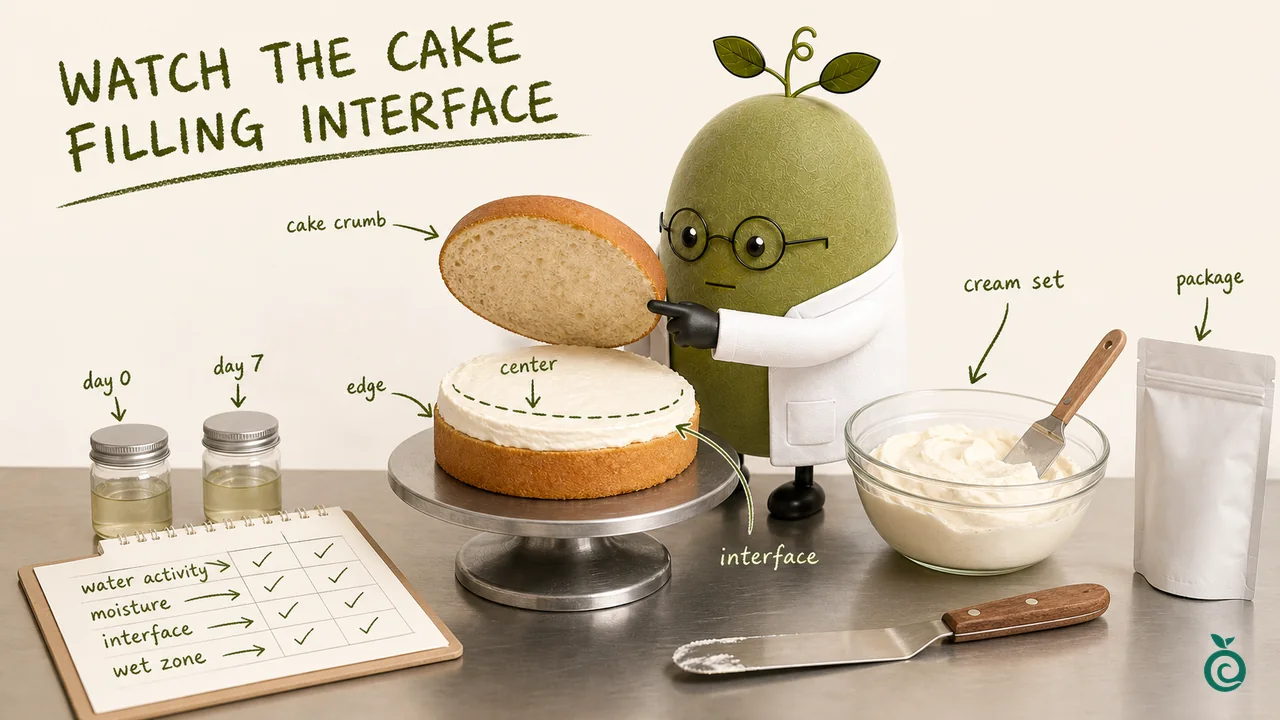
Define the two components before assembly
Write the cake type, crumb target, current sugar system, filling type, fat or dairy system, and whether the filling is baked in, injected, spread or layered after baking. Keep the current or sucrose control visible. A cake layer and a pastry cream may share a final product, but they do not share the same texture method or storage risk.
Measure moisture and aw without inventing a pass line
Use the project's agreed methods for moisture and water activity, and record sample temperature and preparation. Water activity describes the availability of water; moisture content describes the amount present. The useful question is whether the two components and the package remain in the intended range for this product, not whether one number works for every filled cake.
Inspect the center, edge and interface
At each checkpoint, record center and edge firmness, springiness, cohesiveness, adhesiveness or sensory equivalents. For the filling, record flow, set, spreadability, syneresis, surface crust and bite. At the interface, note sogginess, sticking, drying, visible wet zones, filling squeeze-out and any change in layer definition.
Use a time ladder after cooling
For an initial screen, day 0 after cooling and days 1, 3 and 7 are example checkpoints, not a universal test schedule. Choose timing that fits the product and intended storage. Keep package, temperature, humidity, light and opening history consistent. Use separate matched packs for destructive checks so opening the day-zero pack does not change every later result. This short screen locates changes; it does not establish commercial shelf life or microbiological safety.
Record cake, filling and interface separately
Use one record for each formulation, batch, package and checkpoint. Compare the control and trial using the same methods and sample locations. Enter measured values with units where a method is defined; otherwise use a consistent sensory scale and reference sample.
| Test area | Record for control and trial | Comparison to make |
|---|---|---|
| Cake crumb | Center and edge firmness; springiness; sample size and test temperature. | Does the change affect the whole crumb or mainly the exposed edge? |
| Cream filling | Flow, set, spreadability, water release and test temperature. | Does the filling change when stored alone as well as inside the cake? |
| Cake–filling interface | Wet or dry zones, sticking, layer definition and filling squeeze-out; labelled photos. | Is the defect concentrated at contact between the two components? |
| Water measurements | Moisture and aw for each component; method, preparation and temperature. | How do values change from the starting point under comparable conditions? |
| Package and storage | Pack ID, seal, storage conditions, elapsed time and opening history. | Are the samples comparable, or has handling changed the exposure? |
| Decision | Main defect, comparison with control and next variable to test. | Which observation supports changing the next sample? |
Keep a retained component sample where it is meaningful and safe to do so. A filling tested alone and one in an assembled cake answer different questions; record both rather than averaging the results into one texture score.
Use packaging as part of the test
Record the package format, seal, barrier information when available, headspace or opening condition and storage environment. If the cake edge dries while the filling softens, the package and component water balance deserve review alongside the sweetener. Do not credit or blame a sweetener before the package and process are held steady.
Let the failed row choose the next sample
If sweetness fails, narrow the sweetener comparison while holding the cake and filling structure steady. If the cake loses volume, review batter and bake variables. If the interface becomes wet or sticky, review component water balance, filling set and packaging. If the filling dries or cracks, test its own solids, fat, hydrocolloid or process question where the market and formula allow it.
What the cited studies support
Luyts and colleagues studied pound-cake crumb firming and found a substantial role for moisture migration in their conventional cakes. Godefroidt and colleagues discuss why sucrose replacement changes cake systems beyond sweetness. Renzetti and colleagues tested coordinated sugar and fat reformulation in a defined pound-cake model. Patrignani and colleagues studied a honey biscuit filling, not a filled cake. These sources support looking at components, structure and storage separately; none supplies a universal acceptance limit or a validated Hengliyuan formula.
Discuss the next filled-cake sample
Send the cake and filling types, current sweetener system, assembly process and the main defect. A photo of the interface and a short control-versus-trial record can make the problem easier to explain. Start with what you know; packaging, market, quantity and document needs can be clarified during the discussion. Reviewed October 16, 2026.
Record these fields before comparing filled-cake samples
- Cake type and filling type
- Current or sucrose control
- Cake center and edge texture
- Filling flow, set and texture
- Moisture and aw methods
- Cake–filling interface observations
- Package and agreed storage checkpoints
- One main variable changed
Common questions
Why can a filled cake become soggy at the interface?
The cake and filling can have different water balances, and moisture may move during storage. Filling composition, cake crumb, package and temperature also affect the result.
Discuss this requestShould cake and filling use the same aw target?
Do not copy one target across products. Set the method and decision range for the actual cake, filling, package and market, then check the assembled interface over time.
Discuss this requestCan a day-zero filling texture prove storage stability?
No. Repeat cake, filling, interface, package and sensory observations at the project's agreed checkpoints. A short screen is not a shelf-life claim.
Discuss this requestWhat should buyers send before requesting a filled-cake sample?
Start with your target market and product idea. Share any known packaging specification, estimated quantity, required certificates/documents and whether samples are needed; we can clarify the remaining details together. Add cake type, filling type, process, storage and the main defect.
Discuss this requestWhat should I do if the cake is firm but the interface is wet?
Keep those as two observations. Compare center and edge crumb, the filling on its own, and the assembled interface under the same storage conditions. Review component water balance, filling set, package and process before attributing both defects to the sweetener.
Discuss this request