
Read this guide in
PROTEIN BAR STORAGE TEST
Protein Bar Storage Hardening Sweetener Scorecard
Compare protein-bar sweetness and stored texture with matched test conditions, a practical record table and a free Excel checkpoint sheet.
A protein bar can reach the target sweetness on day one and still fail after storage. Hardness, dryness, stickiness, chew, color and aftertaste can move as the protein, binder, water and packaging settle into the bar matrix.
This scorecard is for protein bar brands, sports nutrition developers, contract manufacturers and ingredient buyers. Use it to separate sweetness approval from storage texture approval before choosing monk fruit, stevia, allulose-supported or erythritol-free sample directions.
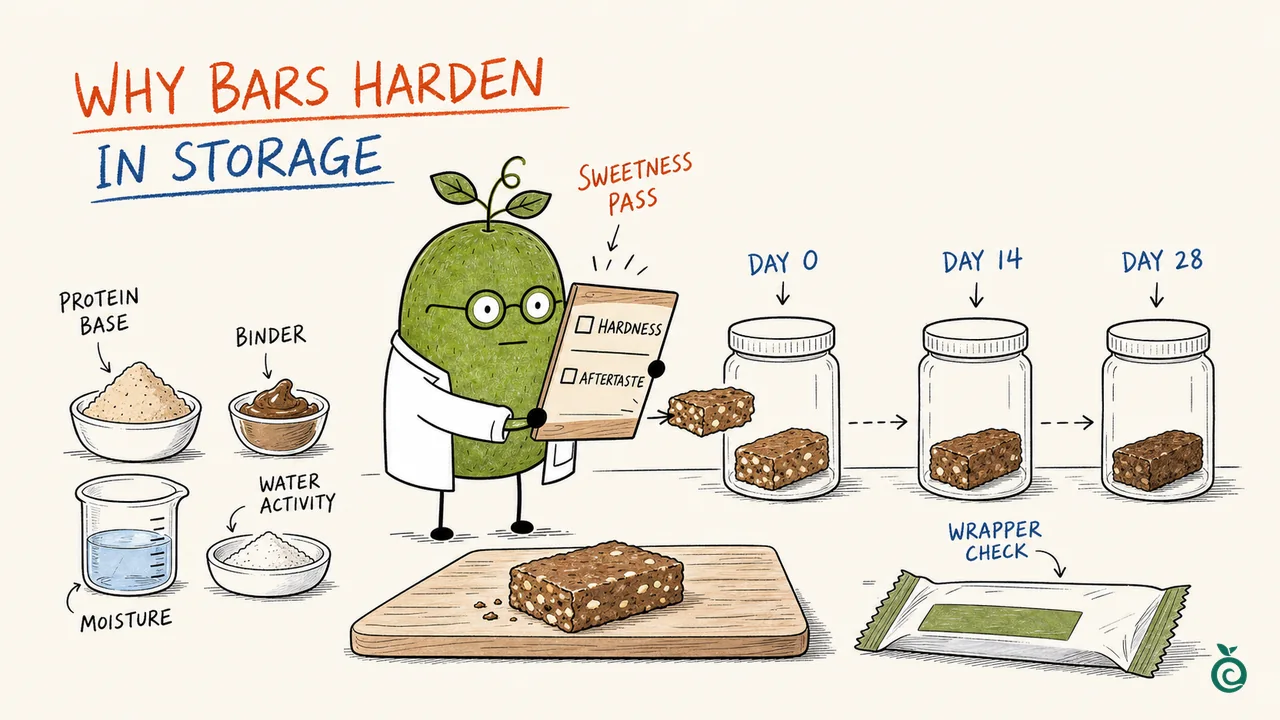
Keep sweetness and stored texture as separate decisions
A sweetness pass does not establish that a bar will retain an acceptable bite, shape or wrapper release during storage. Record the protein, binder, moisture, water activity and actual pack alongside taste. The pictured jars and day 0/14/28 bars are a concept illustration, not a validated package, test schedule or measured hardening result.
Separate sweetness approval from texture approval
Start with two decisions: does the finished bar reach the target sweetness, and does it keep an acceptable bite during storage? Keefer et al. (2020) matched bars for sweetness across protein and sweetener types. Taste profiles differed, but the authors did not find that non-nutritive sweeteners worsened bar hardness in that model. We therefore do not blame a sweetener name for hardening; we compare the complete bar, its process and storage record.
Map the protein bar matrix
Record the protein source and its share, then list the sugar, syrup, polyol, rare sugar, fiber, hydrocolloid, fat, water, cocoa, nuts, fruit pieces and coating. Add bar weight, mixing and forming steps, process temperature, target aw, packaging barrier and storage temperature or humidity. These details help show whether the sweetener is being asked to provide sweetness, bulk, binding, moisture control or only a small sweetness lift.
Use a fixed storage ladder
Keep control and candidate bars under the same stated storage and packaging conditions. A practical first screen can use days 0, 7, 14, 21 and 28, adding a later checkpoint when needed. State which event starts the clock and record actual elapsed time. The two research schedules below are different experiments. The hotter study is not a direct conversion into months at room temperature. Neither schedule establishes the shelf life of another bar.
| Published model | Storage conditions | Reported checkpoints |
|---|---|---|
| Movaghar et al. (2026), gum-containing protein bars | 25°C; a 28-day research window | Days 0, 7, 14, 21 and 28 |
| Keefer et al. (2020), 15 iso-sweet protein/sweetener bars | 35°C and 55% relative humidity; 35 days | Days 1, 7, 14, 21, 28 and 35; first reading was day 1, not day 0 |
Agree project criteria before comparing results. Use separately identified pieces or bars for destructive tests and record the number of independent samples. Do not return an opened or tested bar to an unopened-pack storage series.
Score bite, moisture and aftertaste together
At each checkpoint, record instrumental or sensory hardness, cohesiveness, chew count, crumbling, stickiness, surface moisture, dryness, color, water activity and moisture migration in the wrapper. Taste the finished bar for sweetness onset, peak sweetness, lingering sweetness, bitterness, metallic or licorice-like notes, protein flavor and aroma. Keep the scorecard tied to the same sample code and storage history.
Keep the measurement method beside each checkpoint
Define the comparison with this table, then record actual findings in the paired Excel sheet. Use one copy for a control and candidate at one checkpoint, retaining the same trial reference across the series. Its 32 paired fields are blank; it has no automatic score or pass threshold. Download directly without an email address.
| Check | Record with the result | Comparison limit |
|---|---|---|
| Sample and storage identity | Formula/sample code, batch, pack/seal, storage start, actual elapsed time and conditions | A new formula, coating or pack is a changed comparison. Identify it rather than pooling results. |
| Hardness or cutting | Instrument, probe/blade, test-piece geometry, orientation, speed, temperature, units and replicates | Compression, cutting and sensory hardness are different measurements. Retain raw readings or their file reference. |
| Shape and wrapper release | Crumbling, deformation, sticking and the handling or opening method | Lower hardness alone is not acceptance: a soft bar can stick or lose shape. |
| Water activity | aw value, measurement temperature, method and sample preparation | aw is dimensionless. It is not moisture percentage or a shelf-life conclusion. |
| Moisture content | Result and units, wet/dry basis, method and preparation | Wet-basis and dry-basis percentages are different quantities. |
| Taste and chew | Coded sample, tasting temperature, portion, sweetness timing, chew, dryness and aftertaste | Descriptive notes and liking are different. Agree scale anchors before using numerical scores. |
| Checkpoint decision | Pre-agreed limit, actual finding, missing result and specific next check | Keep texture, taste and pack findings separate. Blank or not measured does not mean zero or pass. |
A change from the first checkpoint is useful only when the measurement remains comparable. If reporting a percent change, identify the baseline, method and units; a missing or zero baseline cannot support an ordinary percentage calculation. Retain unrounded source readings with any summary.
Turn the scorecard into a supplier brief
A useful first round normally keeps the current or sucrose control and compares one or more candidate routes at a defined sweetness target. If the project considers monk fruit, stevia, allulose-supported or erythritol-free systems, state the role expected from each route. Do not treat a high-intensity sweetener as an automatic replacement for syrup solids, binding or moisture control.
Can allulose replace the protein-bar binder?
Allulose can be part of a binding syrup, but replacing an existing syrup with it does not establish adequate binding or storage texture. In the published EP4420527A2 patent examples, one allulose-containing high-protein bar lost its shape and stuck to the packaging during storage. Adjusting the rest of the syrup system produced bars that could be evaluated. These are applicant-reported formulation examples, not an independent validation, a Hengliyuan recipe or permission to reproduce a patented process. For an allulose trial, record the supplied syrup’s solids and allulose assay separately, the other binder ingredients, protein system and final water addition. Compare the current binder, an allulose substitution and any revised binder system under the same forming, packaging and storage method. Check shape retention and wrapper adhesion as well as hardness and water activity. A softer bar can still fail through excessive sticking; a day-one pass does not establish shelf life.
Technical references
Keefer et al. (2020) compared 15 iso-sweet bars using pea, milk or whey protein isolate and five sweeteners; taste and texture differed without a negative effect of the non-nutritive sweeteners on hardness in that model. Movaghar et al. (2026) followed storage changes in bars with Arabic or Persian gum over 28 days. Małecki et al. (2022) compared syrup types and chocolate-coated versus uncoated bars in a whey-protein-concentrate model; it was not a comparison of whey, pea, soy and rice protein sources. These are research models, not Hengliyuan formulations or commercial shelf-life validations.
Start with the storage problem you can describe
Tell us the bar type, final market and what changes during storage: hardening, dryness, sticking, loss of shape or an unwanted finish. Add the current protein or binder direction and pack details if known. A complete dataset is not required to begin a sweetener-sample discussion. For the next comparison, agree the candidate role, control, addition basis and measurements. Keep material identity, sample version and matching product documents with the trial. Texture screening, the supply offer and evidence for the final storage claim are separate decisions.
Common questions
Why can a sweet enough protein bar still harden?
Protein, binder, water distribution, process, packaging and storage conditions act together. Compare the complete bar under matched conditions. A changed taste profile does not identify the cause of a hardness change.
Discuss this requestDid the 2020 study show that monk fruit or stevia worsened hardness?
The authors reported taste-profile differences but did not find a negative effect of non-nutritive sweeteners on hardness in their iso-sweet bar model. This supports separating taste from texture, rather than guaranteeing every protein, binder or pack.
Discuss this requestMust every test use days 0, 7, 14, 21 and 28?
No. That is one possible screening sequence and the reported 2026 research schedule. The 2020 accelerated study began measurements on day 1 and continued through day 35. Define the project baseline, elapsed-time convention, pack and temperature first.
Discuss this requestAre water activity and moisture content the same?
No. Record aw without percent units, together with measurement temperature. Record moisture content with its method, units and wet/dry basis. Neither replaces the other or establishes safety or shelf life on its own.
Discuss this requestDoes a softer bar automatically pass the storage check?
No. Check shape, cohesion and wrapper release too. The cited patent includes an allulose-containing example that lost shape and stuck to its package; applicant-reported examples are not independent product validation.
Discuss this requestDoes the Excel sheet give an automatic score or shelf-life result?
No. It is a blank paired record for one control/candidate checkpoint, with 32 fields and space for methods and actual findings. Agree limits separately and retain raw records. Downloading or filling it is not required to contact us.
Discuss this requestWhat should we send for a sweetener-sample discussion?
Begin with the bar type, target market and observed storage problem. Add any known protein or binder direction, addition basis, pack and results. We can clarify the next comparison before final quantity, documents and quotation scope are settled.
Discuss this request