
Read this guide in
DOSAGE AND PILOT GUIDE
Monk Fruit Sweetener Dosage and Pilot Batch Testing Guide
A practical guide for buyers moving from monk fruit sweetener dosage screening to bench samples, pilot batches, taste notes and quotation-ready feedback.
Monk fruit extract is a high-intensity sweetener, so small dosage changes can create a big taste difference. Buyers often get better results when they record a structured bench test before asking for final quotation.
This guide helps food, beverage, powder, bakery and OEM teams turn early dosage screening into useful supplier feedback.
Confirm what sample you are testing
Before dosage work, confirm whether the sample is pure monk fruit extract, a Mogroside V grade, a granulated blend, a syrup direction or a finished sweetener system. The starting point changes by product identity.
Use a small dosage ladder
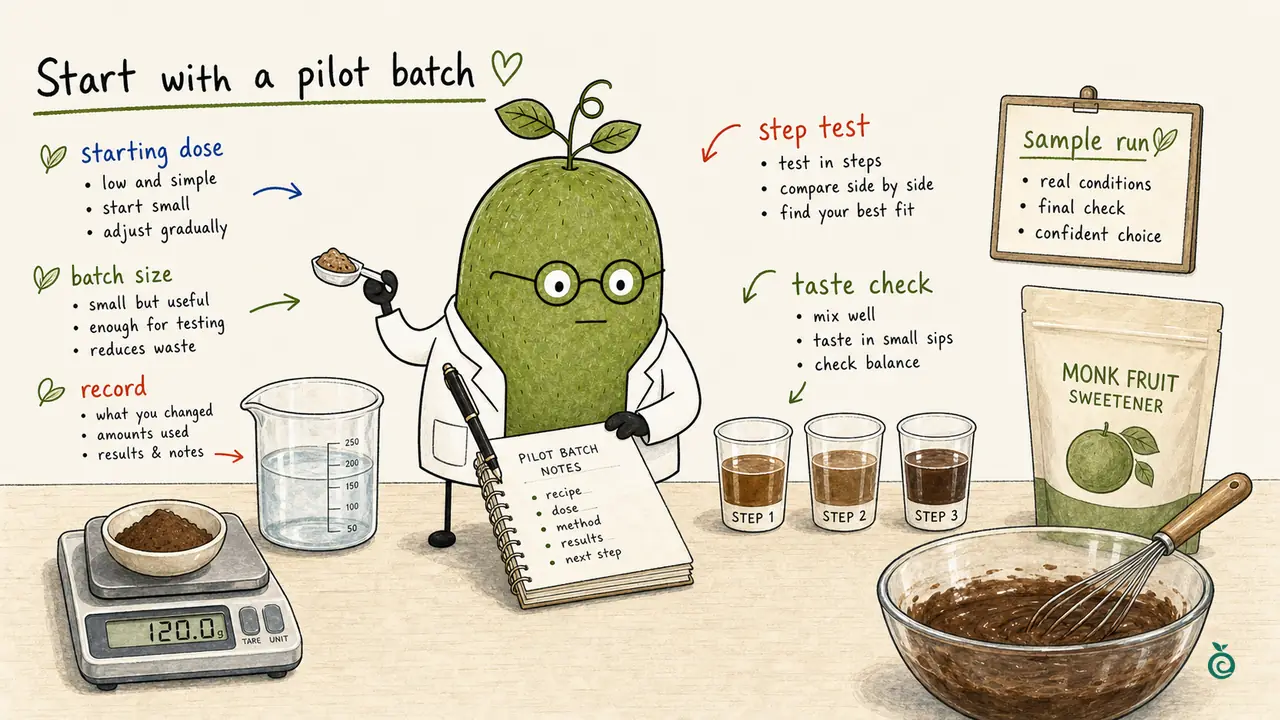
Instead of jumping to one level, prepare several small steps around the expected sweetness range. Record the exact batch weight, water level or serving size so the result can be repeated.
Test inside the real application
A dosage that tastes clean in water can be too strong in tea, too thin in dairy, too lingering in a protein drink or too sweet in a fruit acid system. Application testing is more useful than a dry comparison.
Separate sweetness from body
Monk fruit can provide sweetness, but sugar also provides bulk, texture, browning, viscosity or freezing behavior in many products. Buyers should note when another carrier or blend is needed.
Pilot batches should record practical feedback
Useful notes include sweetness onset, aftertaste, bitterness, mouthfeel, solubility, pH if known, processing temperature, storage result, packaging behavior and whether consumers will use the product hot or cold.
Make feedback quotation-ready
When a sample direction is close, send target market, product type, packaging specification, estimated quantity, required certificates or documents and whether additional samples are needed.
Example dosage ladder: use verified starting advice
Set the first ladder from the selected material’s written application guidance and the product team’s assessment. This guide does not publish an unverified V50 dose for RTD tea. An extract assay describes material composition; it is not a complete recommendation for a drink containing tea solids, acids, flavors or other sweeteners. Ask for guidance tied to the actual grade, carrier and beverage before assigning a starting mass. A ladder can compare a lower, a central and a higher candidate around that agreed starting point, with a separately coded current control. The labels below are record fields, not numeric dosing instructions. Choose the spacing with the application team, keep the total base comparable, and verify that the balance can measure the intended addition accurately. For a very small dose, document a suitable premix or stock preparation, including its concentration and contribution to the batch. Decide whether the goal is equal sweetness, partial sugar replacement or a specific aftertaste improvement. These are different screens. If all sugar is removed, also record how the formula’s mass and other functions are addressed. Keep the tea extraction, water, acid, flavor and serving conditions fixed while adjusting the sweetener dose. Do not change the tea strength and dosage together and then attribute the result to monk fruit. Taste coded samples in a consistent order with the same preparation and rest. Record initial sweetness, peak, finish, bitterness, astringency and any deposit separately. Repeat a promising candidate before moving to a larger batch, particularly when the difference is small or preparation accuracy is uncertain. The accepted dose is a result in the defined product system, not a conversion rule for every food.
| Code | Dose direction | Source of starting advice | Measured addition | Decision |
|---|---|---|---|---|
| Control | Current formula | Current batch record | Enter actual mass | Benchmark |
| L1 | Lower candidate | Record approved starting reference | Enter actual mass | Taste and physical observations |
| L2 | Central candidate | Same reference | Enter actual mass | Taste and physical observations |
| L3 | Higher candidate | Same reference | Enter actual mass | Taste and physical observations |
Batch record template
Record what went into the sample before evaluating it. Include the extract batch and grade, total formula mass, actual sweetener addition, any stock or premix concentration, the water mass and the identity of other sweeteners. Then record pH, processing, serving temperature and the tasting time. A later team should be able to reproduce the sample without guessing which spoon, stock or preparation was used. For scale-up, preserve the accepted composition but review the weighing, premixing and addition method separately. Equipment, mixing geometry and sampling can change. Compare material from multiple relevant positions or filling stages, with an appropriate analytical method when uniformity needs measurement. Tasting alone cannot establish content uniformity. Keep actual values and deviations beside the batch code. Send the supplier one main question from the result. If sweetness is too low but the finish is acceptable, say that. If the finish lingers or the drink becomes cloudy after a defined storage period, give the time and condition. This information is more useful than “make it better” because the next sample can change one variable. Retain the old result and mark the new formula version so approved and rejected trials are not confused.
| Field | What to enter |
|---|---|
| Material | Product name, grade, carrier and batch |
| Weighing | Formula mass, sweetener mass, stock concentration and water mass |
| Product condition | pH method, process, package and storage history |
| Sensory result | Onset, peak, finish, bitterness and astringency |
| Physical result | Dissolution, clarity, deposit and preparation method |
| Decision | Accept, revise or repeat; one next question |
Calculate the pilot addition on the same basis
For a mass-based trial, divide the actual commercial sweetener mass by the total finished trial mass, then multiply that fraction by the planned finished pilot mass. Keep both masses in the same units. As an arithmetic example, 0.10 g in 1,000 g of finished trial product is 0.01% by mass; preserving that fraction in 100 kg of finished product requires 10 g of the same commercial ingredient. These numbers illustrate scaling only and are not a recommended monk fruit dose. Do not substitute a volume in litres for a mass in kilograms without establishing the relevant density. If the approved trial used a stock solution, record its concentration and calculate the commercial ingredient delivered, rather than scaling only the stock volume. Include the stock water or carrier in the total formula. The calculation assumes the same material and composition; a changed grade, carrier or stock concentration needs a new calculation and application check. Confirm accurate weighing and mixing at pilot scale, and check samples across the batch or filling run before accepting uniformity.
Review note
Reviewed October 12, 2026.
Common questions
Why is dosage difficult with monk fruit extract?
Monk fruit extract can be very concentrated, so small changes in dosage, grade, pH, flavor and carrier can strongly affect sweetness and aftertaste.
Should buyers start with water testing?
Water testing can screen rough sweetness, but the final decision should be made in the real food or beverage application.
What should pilot batch notes include?
Record dosage, batch size, application, sweetness level, aftertaste, solubility, processing conditions, storage result and packaging observations.
How can Hengliyuan use buyer feedback?
Clear feedback helps Hengliyuan discuss a better sample direction, blend option, document set and quotation based on the actual project.
