Read this guide in
Hengliyuan Applications and Selection
Food-Grade Sucralose Buying Guide: Assay, Particle Size, Batch COA, and Price
Compare pure sucralose powder with blends, read 98–102% assay and batch COAs, calculate trial quantities, and check particle form, heat conditions and 25 kg quotes.
Food-grade sucralose powder is a high-intensity sweetener ingredient, not a spoon-for-spoon sugar replacement. Before buying, match the product identity, applicable specification, batch COA and physical form to your formula. FDA describes sucralose as about 600 times sweeter than table sugar; that figure explains the need for accurate weighing, but does not establish your finished-product dose.
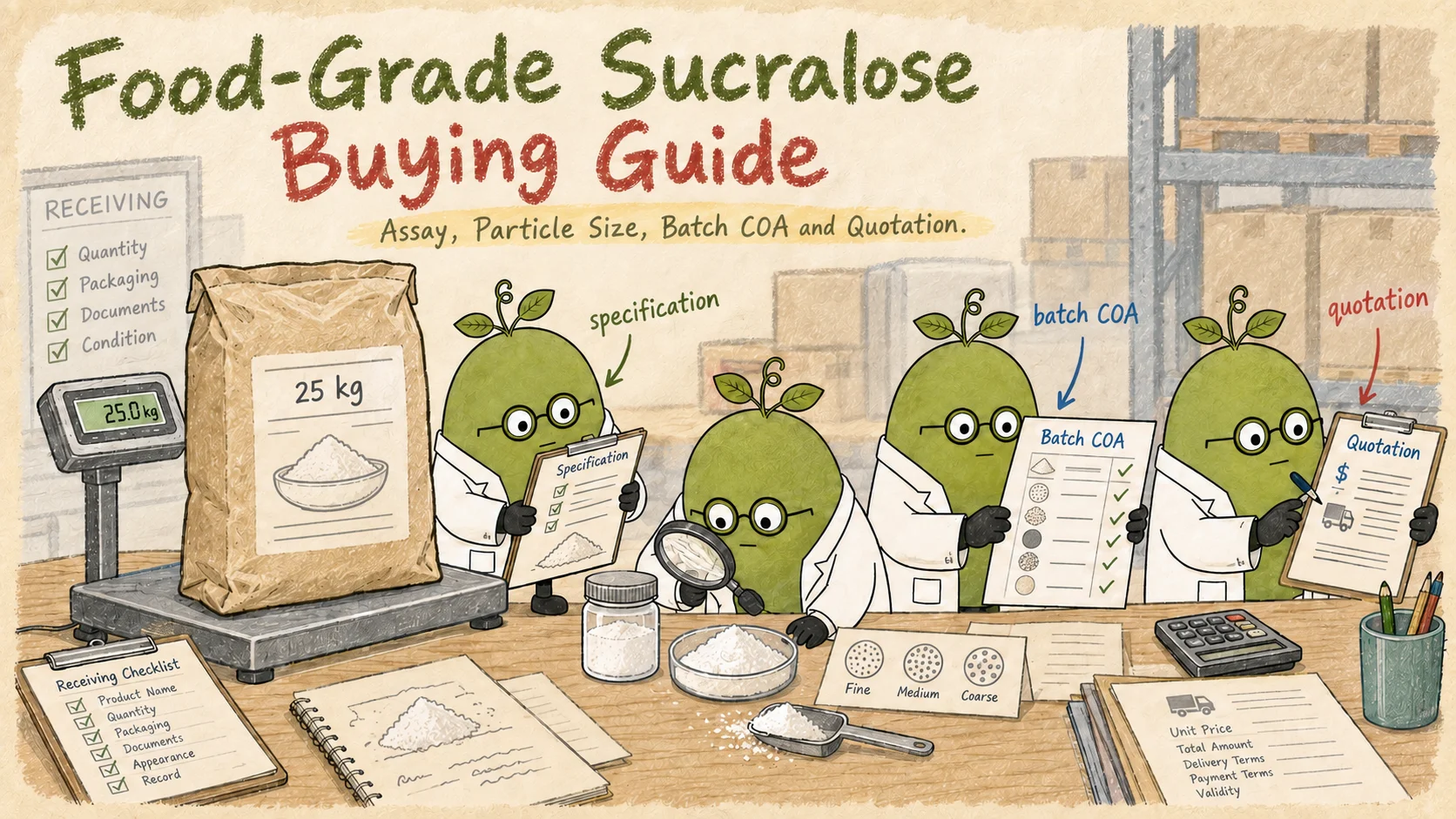
Hengliyuan supplies sucralose powder in 25 kg bags, with one product specification currently offered. This guide separates published reference limits and other suppliers’ examples from our own supply information. Request the current specification and a matching sample-batch COA before deciding whether the offered material meets your acceptance standard.
What is sucralose powder made from?
Sucralose is manufactured by chemically modifying sucrose. Three selected hydroxyl groups are replaced with chlorine atoms. The resulting compound is a different substance from sugar: CAS 56038-13-2, molecular formula C12H19Cl3O8, also identified as INS 955 or E 955 in relevant additive systems. It is an artificial high-intensity sweetener rather than a sugar alcohol or a plant extract. JECFA describes the ingredient as a white to off-white crystalline powder and identifies sweetness as its function. The chemical identity does not tell you whether a particular retail powder also contains a carrier. For procurement, check the ingredient statement and the release specification as well as the name on the front of the pack.
Specify pure sucralose or a complete sweetener blend
Sucralose powder and an erythritol–sucralose blend have different compositions and use levels. State which material you want before comparing quotations. A lower price per kilogram is not a useful comparison if the products perform different jobs. Choose the raw-material discussion when you already control the individual ingredient doses in your formula. If you also want to change sweetness strength or the way the sweetener is handled, discuss a complete blend separately, including its composition and target sweetness. This guide covers sucralose powder. For a blend comparison, use the separate dose-and-cost guide. A real example is Splenda Granulated Sweetener: its US product page lists maltodextrin and Splenda Sucralose and gives cup-for-cup sugar conversions. Those are directions for that finished product. They do not apply to high-assay sucralose powder. A no-erythritol statement also does not mean a product is carrier-free.
- Compare erythritol–sucralose blend dose and cost
- View food-grade sucralose powder
- Splenda Granulated: ingredients and product-specific conversions
| Material | What to establish before comparing |
|---|---|
| High-assay sucralose ingredient | Identity, assay basis, complete specification, physical form and batch documents |
| Sucralose premix | Sucralose concentration, carrier, other sweeteners and intended addition rate |
| Retail tabletop product | Full ingredient list, product-specific conversion, serving and label information |
Pure ingredient, premix and retail product can all be described online as “sucralose powder.” Compare the actual materials, not just their search titles.
Read a named specification rather than a generic purity claim
For the United States, 21 CFR 172.831 identifies sucralose and incorporates the Food Chemicals Codex, seventh edition (2010), pages 993–995. It permits use in foods generally under current good manufacturing practice, at no more than the amount reasonably needed for the intended effect. A supplier’s “food grade” label is not a substitute for demonstrating the applicable requirements. The following values come from the public JECFA monograph prepared in 1993 with metals revisions in 2004. They are reference points for reading documents, not a declaration of Hengliyuan’s batch results, a complete purchasing specification, or a replacement for the standard and current rules that apply to your destination.
- 21 CFR 172.831: US identity, incorporated specification and use conditions
- JECFA: public reference limits and test methods
| JECFA reference item | Published requirement | How to read it |
|---|---|---|
| Assay | 98–102%, anhydrous basis | Match the reporting basis and assay method; this is not 98–102% HPLC area |
| Water | No more than 2.0%; Karl Fischer | Water is a named test, not an interchangeable loss-on-drying result |
| Specific rotation | +84.0 to +87.5 degrees; 10% w/v solution | Retain the method and solution conditions |
| Sulfated ash | No more than 0.7% | A separate purity test; not an assay calculation |
| Methanol | No more than 0.1% | A residual-solvent limit, not permission to use methanol in food preparation |
| Lead | No more than 1 mg/kg | Match the applicable market standard and a sufficiently sensitive method |
| Triphenylphosphine oxide | No more than 150 mg/kg | Review process-related impurities as well as the main assay |
The monograph also includes identity tests and tests for other chlorinated disaccharides and chlorinated monosaccharides. Do not approve an order from this shortened table alone. FCC, JECFA and pharmacopeial labels are not interchangeable certificates; ask which edition and individual requirements the offered lot meets.
Why can a sucralose assay specification extend to 102%?
An assay is a result reported against a reference standard using a specified analytical method. The 98–102% acceptance interval is the interval written into the referenced monograph. It does not mean a powder can physically contain more than its own mass of sucralose, or that a 101% result makes it sweeter than another compliant lot. Ask the laboratory to explain the reference value, calculation, reporting basis and uncertainty when a result needs interpretation. Do not compare an anhydrous assay directly with an as-supplied concentration or chromatographic area percentage. If a laboratory confirms that water is the only correction required, a hypothetical 99.5% anhydrous assay with 1.0% water corresponds to 99.5% × 0.99 = 98.505% on an as-supplied mass basis. The example explains the basis conversion; it is not an actual batch result or a reason to alter a validated formula automatically.
| Document wording | What it establishes | What it does not establish |
|---|---|---|
| 98–102% specification | An acceptance interval | The measured result for the delivered lot |
| 99.5% anhydrous assay | A reported result on that basis | 99.5% of the as-received mass without checking corrections |
| HPLC area % | Relative chromatographic signal under that method | An automatically equivalent mass assay |
| Conforms / passes | A stated outcome against a requirement | A numeric result, uncertainty or full impurity profile |
A published batch COA shows why the lot matters
The Sucralose Company publishes a supplier-reported panel for lot TSC-26001, filled July 1 and released July 3, 2026. It reports 99.73% assay on an anhydrous basis, 0.09% water and +85.9 degrees specific rotation. The page names Anhui Jinhe Industrial Co., Ltd. as the testing laboratory. These are that supplier’s published results, not independent testing by Hengliyuan or results for our material. Its separate document portal gives typical assay and water values of 99.4% and 0.21%. This is a useful distinction: typical values and a named lot’s results serve different purposes. A purchasing decision needs the document for the actual offered or delivered batch, not whichever table looks more precise.
| Item to inspect | Question to resolve |
|---|---|
| Lot, release date and issuer | Does the document match the sample or delivery label? |
| Method and reporting basis | Is it the required test with comparable units and conditions? |
| Result reported as < a threshold | Is the threshold low enough to judge your limit? It is not zero. |
| “Undetected” without a threshold | Request the detection or quantification limit and the method. |
| A missing required analyte | Request a suitable test or keep acceptance unresolved; do not infer it from another result. |
A public COA helps explain how to read a record. It does not authenticate an unrelated shipment or prove every future batch will have the same values.
Keep food ingredients separate from research materials
An online search for sucralose COAs also returns analytical standards and research chemicals. For example, MedChemExpress’s public HY-N0614 batch 415763 certificate reports 98.0% purity by NMR and states “For research use only.” Its assay technique and intended use differ from the food-ingredient procurement task. The same CAS number and a plausible purity number do not establish food suitability. Ask for the offered food ingredient’s release standard, manufacturing and traceability documents, and the tests your market and quality system require. An SDS describes handling hazards; it does not replace a food-grade specification or batch COA. Likewise, a supplier’s USP or pharmacopoeial description does not by itself approve every food use.
Particle form affects handling, not just the assay
Hengliyuan currently offers one sucralose product specification. Check the available particle information against your weighing, screening, mixing and dosing method before assuming another mesh option is available. For dry blending, test the sample through the relevant mixing, transfer and filling steps. Assess uniformity separately: meeting a particle-size requirement does not prove that a low-dose ingredient is evenly distributed. For liquid preparation, record the actual dose, water or base, temperature and mixing conditions. Confirm dissolution and handling under those conditions rather than approving the material from its appearance alone. A coarse powder, standard powder and micronized powder can share an assay specification while behaving differently during charging and transfer. Ask for the sieve aperture or particle-size distribution, test method and percentage passing. A bare mesh number does not describe the whole distribution, and mesh naming should be tied to the relevant sieve standard. Where handling matters, request available bulk-density, flow and dust information rather than inferring them from a photograph.
| Process | What to record in the trial |
|---|---|
| Weighing and charging | Balance minimum weight, repeatability, transfer loss and safe powder handling |
| Dry mixing and filling | Premix sequence, mixing time, sample locations and beginning/middle/end of the filling run |
| Liquid preparation | Actual concentration, water/base, temperature, agitation and time to complete dissolution |
| Scale-up | Changes in mixer loading, equipment, transfer distance and hold time |
JECFA describes sucralose as freely soluble in water. That is not a guarantee of instant dissolution in cold protein drinks or a complete premix. If material remains, distinguish undissolved sucralose from insoluble components elsewhere in the formula.
Calculate trial quantities before weighing a high-intensity powder
FDA’s approximate 600-fold sweetness description is a starting reference, not a universal conversion. Sweetness depends on the concentration and complete food system. The arithmetic below assumes 600-fold relative sweetness and ignores assay corrections so the calculation is easy to follow. It is illustrative, not a production recommendation or a finding from a taste panel. If a 100 kg finished batch originally contains 10 kg sucrose, dividing 10,000 g by 600 gives about 16.7 g sucralose for an initial sweetness calculation, or about 167 mg/kg in that final 100 kg batch. This replaces a sweetness contribution; it leaves almost all the original sugar mass to be dealt with elsewhere in the formulation. It does not restore body, freezing behavior, browning or water activity.
| Worked calculation | Result under the stated assumption |
|---|---|
| 10,000 g sucrose ÷ 600 | 16.67 g sucralose; no bulk replacement implied |
| 16.67 g ÷ 100 kg finished product | 166.7 mg/kg, approximately 167 ppm on a mass basis |
| 10 kg × 150 mg/kg trial level | 1,500 mg = 1.5 g; 150 mg/kg is an assumed trial level, not a recommended dose |
| 100 mg target ÷ 0.01 mass fraction | 10 g of a hypothetical 1% w/w premix or solution |
Write the finished batch mass and units on the worksheet. A 1% w/w preparation means 1 g ingredient brought to 100 g total preparation, not 1 g added to 100 g carrier. Keep added carrier or water inside the formula balance. Use a suitable balance and a verified preparation method; a kitchen spoon is not a reliable low-dose control. A freshly prepared trial solution has no validated storage life simply because it dissolves.
Real product examples illustrate different buying tasks
Public product pages make useful examples when their limits stay visible. They do not establish that one supplier’s product is superior, or that its retail price is a comparable industrial quote. Read the current item and documents, then compare the task it serves.
- ChemCentral: coarse FCC food-grade powder in a 55 lb drum
- BulkSupplements: sucralose powder, pack sizes and weighing directions
- Molekula: public product specification PDF
| Published example | Useful detail | What to take into your comparison |
|---|---|---|
| ChemCentral product 16159871 | FCC / food-grade coarse powder, 55 lb drum | Check form, net mass, pack type and exact offered item; a drum listing does not establish a particular mesh. |
| BulkSupplements Sucralose Powder | Packs from 100 g to 25 kg; about 30 mg suggested serving and a milligram-scale instruction | Retail serving guidance explains weighing sensitivity, not the dose for your beverage, protein powder or production batch. |
| Molekula product 90037170 | Downloadable specification separates standard limits from batch results | Use the applicable document type; its specification is not the COA for another supplier’s shipment. |
For Hengliyuan, the confirmed offer in this guide remains one specification in a 25 kg bag. Send a required form or particle-size criterion for checking; these examples do not mean we supply every form shown elsewhere.
Match the specification, sample and delivery batch
The specification defines the agreed acceptance requirements. A batch COA reports results for an identified batch. Read them together, and confirm which batch supplied the sample used in your trial.
| Stage | Record to check | Decision it supports |
|---|---|---|
| Before sampling | Current product specification and your acceptance standard | Whether the offered product is a candidate for the project |
| Sample evaluation | Sample identity, batch documents and trial record | Whether that identified sample meets the document and application checks |
| Bulk delivery | Delivery labels, batch number, matching COA and agreed specification | Whether the delivered lot meets the agreed incoming acceptance requirements |
A sample COA does not represent every future delivery. If the batch number, item or method does not match, ask for clarification and the correct record before acceptance. Carry out the incoming inspections required by your own quality system and the supply agreement.
Validate sweetness and physical performance in the actual application
Use the existing product or sugar control, state the reduction target, and change one main variable at a time where practical. Taste at the intended serving temperature and after the relevant processing and storage stages. Record onset, peak sweetness, lingering sweetness, bitterness or other aftertaste, overall flavor and physical changes separately. A supplier’s “clean taste” description is not a sensory result for your product. If the initial sample is too sweet, recalculate the actual ingredient concentration before adding a masking flavor. If the sweetness is acceptable but the product is thin or icy, address the missing solids and physical function rather than increasing sucralose.
- Ready-to-drink sucralose sample comparisons
- Dry premix uniformity checks
- Separate beverage heating from bakery heating
| Application | Separate checks before approval |
|---|---|
| Acidified beverage | Dissolution, pH, actual thermal history, flavor, retained sweetness and storage condition |
| Protein or electrolyte powder | Blend distribution, reconstitution, mineral/protein flavor interaction and serving-to-serving consistency |
| Frozen dessert | Sweetness plus a separate solids and freezing-point design; a tiny sucralose dose cannot replace sugar’s mass |
| Bakery or high-temperature use | Permitted use and heat-related evidence before trials; finished sweetness alone cannot establish safety |
Agree the pass criteria before comparing samples. A short laboratory taste test does not establish shelf life, microbiological stability or commercial-scale uniformity.
Compare a new source in the current formula
Keep the current ingredient as the control when changing suppliers. Compare the candidate at the intended dose with the other ingredients and process held constant where practical. Record sweetness, aftertaste, overall flavor and dosing or preparation performance. If the material itself changes—for example, from a complete blend to sucralose powder—recalculate and retest the dose. Do not carry over the blend’s addition rate. Record any other formula or process change so the comparison remains interpretable. After the laboratory comparison, complete the production checks needed for the actual equipment and batch size. Document acceptance, sensory fit and process fit are separate decisions; keep unresolved items visible before placing the production order.
Keep heat stability, permitted use and safety assessment distinct
The phrase “heat stable” on a product page is too broad to approve every cooking process. EFSA’s February 2026 re-evaluation retained its ADI of 15 mg/kg body weight per day and identified no safety concern at the reported authorised uses and levels. However, it could not confirm the proposed wider fine-bakery extension because of uncertainty about chlorinated compounds under prolonged high-temperature conditions. That assessment also identifies uncertainty for home-made foods subjected to heating such as baking or frying; it says those conditions are not expected during industrial processing under the currently authorised uses. Do not turn this into either a blanket ban on all heated products or a guarantee for any oven time and temperature. Record the actual process, intended use category and market, and obtain the required technical and regulatory review. FDA’s published US ADI is 5 mg/kg body weight per day. Keep the authority attached to the number: an ADI is a long-term exposure benchmark, not a recipe dose or per-serving limit. Ingredient compliance and an acceptable taste do not establish the safety or label compliance of an entire formula. Individual symptoms or health questions need an appropriate healthcare professional.
- EFSA 2026: authorised uses, high-temperature uncertainties and recommendations
- FDA: US uses and exposure benchmarks
- US food-additive conditions for sucralose
EFSA also recommended consideration of changes to certain impurity and lead specifications. An assessment recommendation is not itself proof that a legal specification has already changed. Check current destination-market requirements rather than silently replacing a COA limit with a recommendation.
Store the ingredient under its own documented conditions
Confirm the offered product’s storage conditions, shelf-life basis and date marking in the current documents. Inspect bag integrity and the batch label at receipt; keep the ingredient dry, protected and resealed as instructed after opening. Record opened-pack handling and reject or hold damaged or unidentified material under your quality procedure. A shelf-life statement for unopened powder does not establish stability in an opened container, a working solution or a finished drink. Another supplier’s storage period is not a promise for Hengliyuan’s material. If the powder cakes or handling changes, investigate moisture exposure, packaging and the relevant tests rather than approving it by appearance alone.
Compare a 25 kg quotation and the cost at the accepted dose
Hengliyuan’s stated pack is a 25 kg bag. Give the number of bags or total mass required and ask the quotation to identify: - The product specification and order quantity. - Currency, price per kilogram, price per 25 kg bag and total amount. - Delivery basis, destination and whether tax or freight is included. - Required documents and any separately agreed testing charges. - Lead time, payment terms and quotation validity. Check the arithmetic on the same price basis: one 25 kg bag contains 25 times the quoted kilogram quantity. Add separately charged items explicitly rather than comparing a delivered price with an ingredient-only price. For cost in use, multiply the accepted dose by the purchase unit price and include relevant formula or process changes. No current price is established by this guide. For an arithmetic example only, assume USD 50/kg and an accepted dose of 0.15 g/kg finished product. One 25 kg bag is USD 1,250 before any separately charged items. Ingredient cost is 0.00015 kg × USD 50/kg = USD 0.0075 per kg finished product, or USD 0.75 per 100 kg. These are invented inputs for checking a worksheet, not Hengliyuan’s price, a market average or an established use level. A cheaper blend per kilogram can still cost more at its required addition rate. Include its carrier, any other ingredients needed to restore texture, weighing or mixing losses and separately charged freight or testing before judging the total cost.
When a trial fails, identify what the next comparison must answer
Keep the document check, dosing check and application result separate. This makes the next sample request useful and avoids repeating the same trial with a different label.
| Observation | Check first | Next useful evidence |
|---|---|---|
| Batch tastes unexpectedly sweet | Unit conversion, ingredient concentration, actual weigh-out and blend identity | Reconciled batch sheet and a controlled sweetness comparison |
| Different sweetness between servings | Premixing, segregation during transfer and filling, sample locations | Documented distribution checks at the relevant production stages |
| Powder or residue remains in liquid | Dose, temperature, agitation and identity of the residue | A controlled dissolution comparison in water and in the actual base |
| Sweetness is acceptable but texture is poor | Lost sugar solids and the rest of the formula | Physical measurements appropriate to that food, not a higher sucralose dose |
| COA result or required item is unclear | Correct lot, method, units and threshold | Corrected documentation or a suitable additional test before acceptance |
Request a specification check and sample
Send your acceptance standard, expected quantity, target market and intended application. Include a required particle specification or special document item at the start so it can be checked against the offered product. If the formula is still in development, describe the product and dosing method. A sample trial can help establish whether the material fits the intended process. Before ordering, connect the accepted sample and specification to the quotation, packaging and delivery-batch documentation. That gives purchasing and production the same reference.
Review note
Reviewed October 23, 2026. Regulatory references, the public JECFA monograph, named supplier examples and document types were checked for this revision. External examples remain attributed to their publishers; calculated examples are labelled as assumptions. This guide does not issue a batch specification, a validated formula, a current quotation or destination-market approval. Match the current product documents and intended use before ordering.
Common questions
What is the current sucralose price per kilogram?
Request a current quotation for the offered product specification and quantity. Confirm currency, price per kg and per 25 kg bag, delivery basis, taxes, freight, document scope and quotation validity. This guide does not publish a standing price.
Discuss sucralose samplesIs a specification the same as a batch COA?
No. The specification defines agreed acceptance requirements; the COA reports results for an identified batch. Match the product, batch, test items, methods and reporting basis before judging acceptance.
Discuss sucralose samplesCan the sample COA cover later bulk deliveries?
No. Match each delivery to its batch labels and documents. Keep the approved specification and sample trial as references, but review the delivered lot against the agreed incoming requirements.
Discuss sucralose samplesDoes Hengliyuan offer several sucralose mesh grades?
This guide describes one currently offered product specification. Send your particle-size and handling requirements so the available data can be checked; do not assume an alternative grade is available.
Discuss sucralose samplesCan sucralose powder replace a blend at the same dose?
No. Their compositions and sweetness strengths differ. Recalculate and confirm the dose in the complete formula, then assess sensory performance, handling and uniformity.
Discuss sucralose samplesDoes a compliant assay approve every food use?
No. Ingredient acceptance, permitted use, exposure and processing conditions require separate review. The cited 2026 EFSA assessment retained its conclusion for authorised uses but could not conclude on the proposed wider fine-bakery extension. An ADI is not a recipe dose or per-serving limit.
Discuss sucralose samplesIs sucralose powder the same as Splenda Granulated?
No. Splenda’s US Granulated product lists maltodextrin and sucralose and has its own cup-for-cup directions. High-assay sucralose ingredient is a different material. Read the complete ingredient statement rather than applying a retail conversion to pure powder.
Discuss sucralose samplesWhat is sucralose made from?
It is made by chemically modifying sucrose, replacing three selected hydroxyl groups with chlorine atoms. The resulting compound is sucralose, CAS 56038-13-2; it is not sucrose, a sugar alcohol or a plant extract.
Discuss sucralose samplesDoes 102% assay mean a product is more than 100% pure?
No. The cited 98–102% interval is an analytical acceptance range on an anhydrous basis. Interpret the method, reference value and reporting basis; it is not a physical mass fraction above 100% or a sweetness ranking.
Discuss sucralose samplesHow much pure sucralose replaces sugar?
FDA describes sucralose as about 600 times sweeter than sugar, but the correct dose depends on the full product. Dividing sugar mass by 600 gives only an illustrative starting calculation. It does not replace sugar’s bulk or validate sweetness, permitted use, processing or shelf life.
Discuss sucralose samplesIs a research-use sucralose COA enough for a food order?
No. The same CAS number and a purity result do not establish food suitability. Obtain the food ingredient’s applicable release specification, batch records and required supporting documents. Research-use material and analytical standards serve different purposes.
Discuss sucralose samplesDoes “undetected” on a COA mean zero?
No. Ask for the method and detection or quantification threshold, and check whether it can resolve your acceptance limit. A result below a stated threshold is not proof of absolute absence.
Discuss sucralose samples