
Read this guide in
CHOCOLATE BEVERAGE SAMPLE CHECKLIST
Sugar-Free Chocolate Milk Sweetener Guide: Stability & Sensory Checklist
Sweetener checklist for sugar-free chocolate milk and cocoa drinks: sweetness timeline, bitterness, mouthfeel, sedimentation and storage stability.
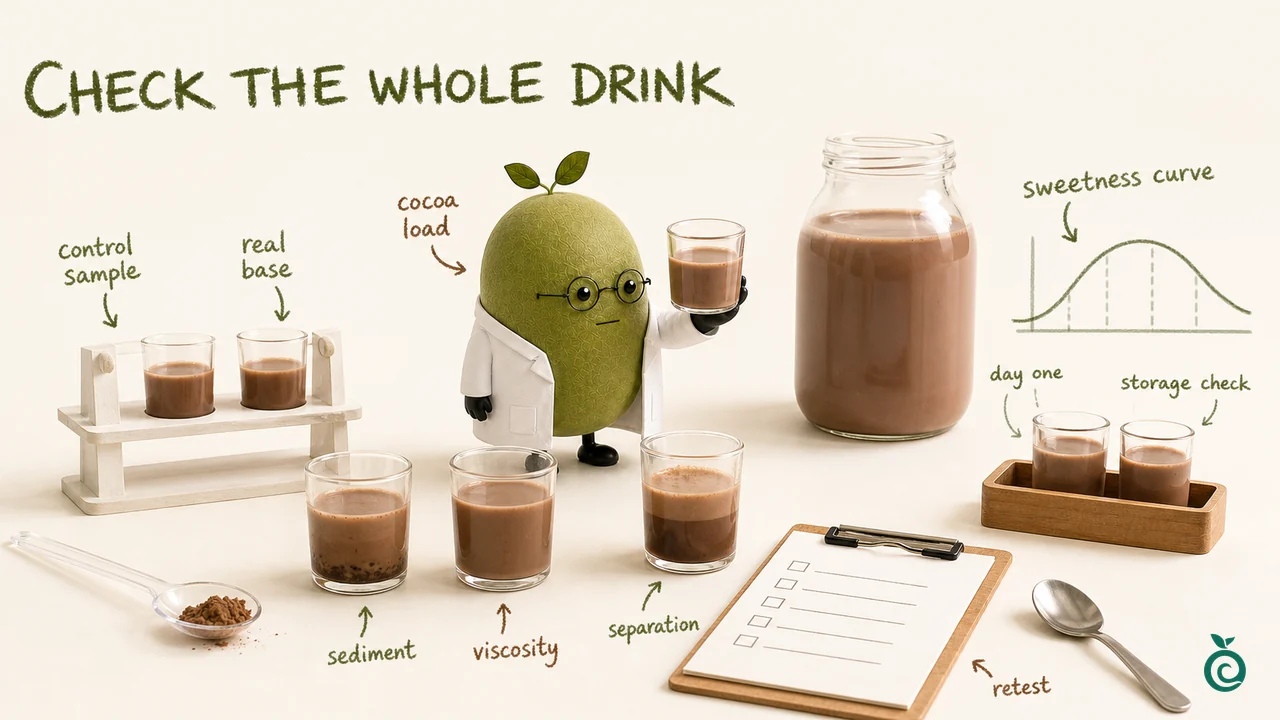
A chocolate beverage can pass a sweetness match and still fail as a product. Cocoa particles may settle, viscosity may feel thin, and a bitter or dry finish may appear only after swallowing.
Use this checklist when a buyer needs a small, interpretable sample matrix for chocolate milk, cocoa drinks or a plant-based chocolate beverage. It keeps sensory, physical and market checks in separate lanes so the next sample has a clear question.
Lock the finished product format
Write down dairy or plant-based, RTD or powder, chilled or ambient, serving size, cocoa source and whether the product is chocolate milk, cocoa beverage, protein drink or another format. Similar names can hide different solids, heat and suspension problems.
Build the matrix around a control
Keep an existing formula or sucrose control. Add the smallest number of comparison directions needed to answer the brief: partial sugar reduction, a high-intensity sweetness lift, an allulose-supported body route or a monk fruit and stevia blend. Do not use a published study as a ready-made commercial formula.
Use a short sensory timeline
At minimum, record entry sweetness, peak sweetness, cocoa intensity and the 30- or 60-second finish. Add bitterness, metallic or licorice-like notes, dryness, thickness, aroma and milk or plant-base character. A single overall score makes it harder to see what changed.
Keep physical checks separate
Record viscosity or thickness, sediment, visible separation, re-dispersion and any powder wetting issue where relevant. A sweetener can be acceptable for taste but unsuitable for the drink's physical system. Keep cocoa, stabilizer, homogenization and heat history in the same sample record.
Plan storage observations
Use the buyer's intended packaging, cold chain or storage condition. Compare day 0 and agreed later points such as day 7, 14 and 21 when appropriate. Note sensory drift, sediment, separation, package condition and any change in chocolate character; do not turn a short test into a shelf-life guarantee.
Close the label and document loop
Before quotation, confirm target market, final food category, ingredient naming, claim direction and required certificates or export documents. The 2020 RATA study found that sweetener profiles changed across food matrices, while China's GB 2760-2024 is an official regulatory starting point rather than a global approval statement.
Turn the checklist into an inquiry
When the matrix is clear, request a sample or quotation with the six buyer fields: target market, product type, packaging specification, estimated quantity, required certificates/documents and whether samples are needed. Add the main sensory or stability question so the first sample is not generic.
Technical references
Reviewed August 2026. Use the 2026 Journal of Dairy Science study for real chocolate milk and temporal dominance of sensations: https://pubmed.ncbi.nlm.nih.gov/41651348/; the 2020 RATA study for matrix-dependent taste profiles: https://pubmed.ncbi.nlm.nih.gov/31968393/; the 2025 consumer-oriented chocolate milk ballot study for storage-sensitive chocolate character and off-notes: https://pubmed.ncbi.nlm.nih.gov/40447096/; and the China GB 2760-2024 notice: https://www.gov.cn/zhengce/zhengceku/202403/content_7001729.htm. These sources support test design, not universal stability, sweetness or compliance claims.
Review note
Reviewed October 2, 2026.
Common questions
What should a chocolate beverage sweetness scorecard include?
Record entry sweetness, peak, 30- or 60-second finish, cocoa intensity, bitterness, metallic or licorice-like notes, dryness, thickness, aroma and the milk or plant-base character.
Why should sedimentation be tested separately from sweetness?
Sweetness and physical suspension are different acceptance questions. Cocoa, stabilizer, homogenization, solids, heat and storage can change sediment or separation without changing the first sweetness score.
Can one chocolate milk study define a universal blend?
No. Studies are tied to their base, cocoa, sweetener grade, process, panel and storage conditions. They can suggest variables for a sample matrix, not a guaranteed commercial formula.
What information should go into a sample request?
Start with your target market and product idea. Share any known packaging specification, estimated quantity, required certificates/documents and whether samples are needed; we can clarify the remaining details together. Add the real base, process and main defect or target.
