
Read this guide in
BREAD TRIAL SCORECARD
Bread Softness and Staling Scorecard for Low-Sugar Bakery Trials
Compare reduced-sugar bread with a control loaf: record proofing, volume, crumb firmness, moisture and stored texture before choosing the next sweetener sample.
Approve a reduced-sugar bread sample only after comparing the cooled loaf and the stored loaf with your control. Our factory view: matching sweetness is not enough if the loaf loses volume or firms faster in its intended package.
Use this scorecard when comparing monk fruit, stevia, allulose-supported, fiber-supported or erythritol-free sweetener directions in yeast bread trials.
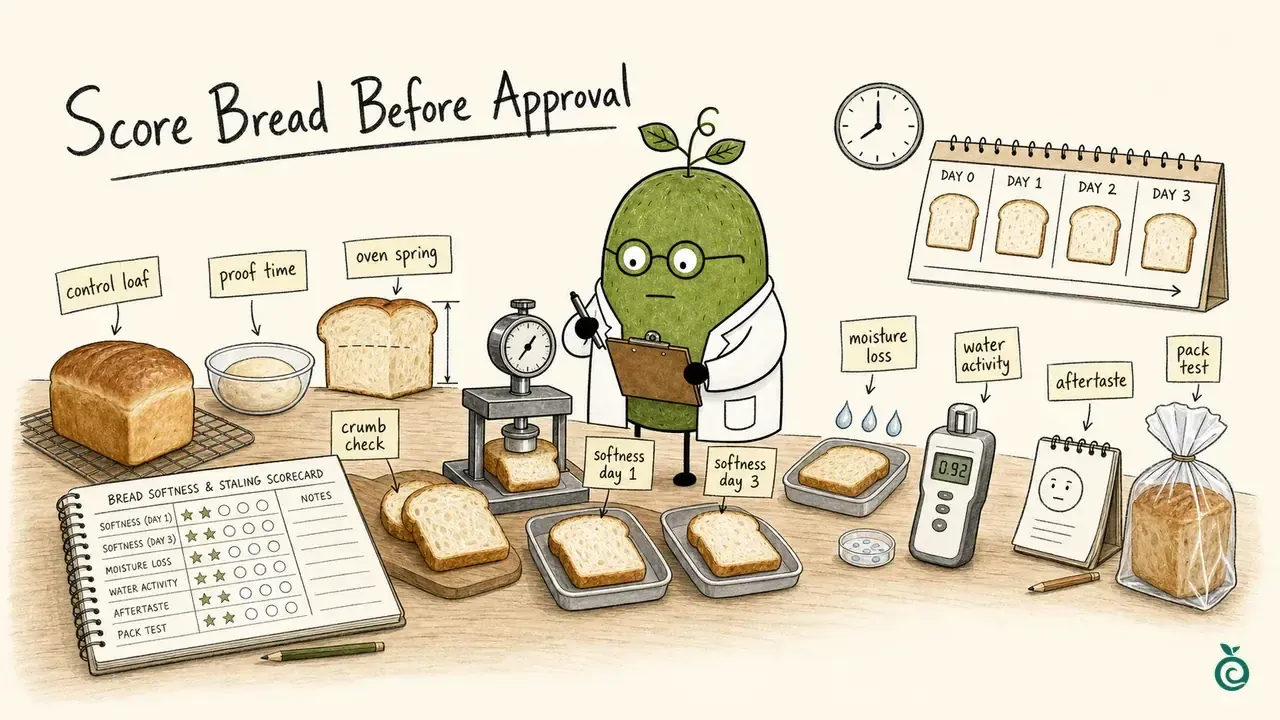
Use a control loaf
Bake the current formula and reduced-sugar candidates in the same session when possible. Record flour, yeast, dough weight, hydration changes, proofing conditions, bake profile, cooled loaf weight and packaging. A control helps separate a formula change from process variation; it does not prove a cause on its own.
| Checkpoint | Record for control and candidate | Keep comparable |
|---|---|---|
| Proofing | Proof duration, conditions and observed rise. | Dough mass, yeast, equipment and endpoint. |
| After cooling | Loaf mass, height or measured volume, crust colour and crumb openness. | Cooling duration and measurement method. |
| Crumb texture | Slice thickness; instrument readings with units, or coded sensory notes. | Slice position, test temperature and method. |
| Moisture | Measured moisture and water activity where available; condensation observations. | Method, sampling point and storage time. |
| Stored loaf | Elapsed time, pack, storage conditions, firmness, dryness, stickiness and taste. | Reference and candidate checked at the same time. |
Use one row per sample at each checkpoint. Leave unmeasured fields blank and record why. Before the trial, agree which differences would justify another sample and which would rule it out; the table supplies no universal pass score.
Score proofing and loaf volume
Check dough rise during proofing, oven spring, finished height, specific volume if available and crumb openness. Weak proofing or small volume may point to fermentable sugar loss, yeast stress, dough handling or water balance, not only insufficient sweetness.
Track crumb softness over time
Compare crumb softness after a defined cooling period and again at the planned storage points. For instrument testing, keep slice thickness, crumb position, temperature, settings and reporting units consistent. For sensory screening, use coded samples and clearly defined descriptions for softness, chew, dryness and stickiness. Record the serving order and vary it across tasters where practical, rather than always presenting the control first.
Measure moisture and water activity
Moisture content, water activity and a taster’s impression of dryness answer different questions. Record each separately when measured. Note bag condensation and whether the crumb feels dry, gummy or sticky, but do not infer water activity or microbial stability from softness. A sensory scorecard does not establish the safe storage life of the bread.
Record sweetness and finish
Record texture and taste separately so one overall score does not hide the problem. Use the same order of checks for each sample. Note sweetness, aftertaste, bitterness, lingering sweetness, crust flavour and any change in the prominence of yeast, wheat, bran, fibre or preservative notes.
Match testing to packaging
Shelf-life checks must match the real pack. A sliced sandwich loaf, burger bun, sweet bread and frozen dough route need different storage questions. Record packaging film, oxygen exposure, storage temperature, freeze-thaw plan and the point at which the bread becomes unacceptable.
Turn scores into the next sample
Choose the next change from the observed defect. Low volume calls for a proofing and structure review; an acceptable fresh loaf that firms during storage calls for a texture, moisture and packaging comparison. Those observations guide the next trial but do not identify a single cause. Change one main direction at a time where practical: sweetness, the bulk system, hydration, proofing, baking or packaging. Record any accompanying changes. Send the control and candidate codes, the actual process and the checkpoint where they diverge, rather than asking only for a softer sweetener.
Technical references
The cited research examines D-allulose with baker’s yeast and a compound improver containing oligosaccharides, sodium carboxymethyl cellulose and D-allulose in sugar-reduced bread. These are formulation-specific studies. They are reasons to measure fermentation and bread quality, not proof that one ingredient alone will reproduce the same result in your recipe. The scorecard above is our practical trial recommendation.
Review note
Reviewed October 16, 2026. Match ingredient selection to current product documents and target-market requirements. Trial records support sample selection; production release and shelf-life validation remain separate checks.
Common questions
How long should a reduced-sugar bread trial be checked?
Check the loaf after cooling and again through the intended storage window. For sliced bread, one-day and multi-day checks are more useful than day-zero tasting only.
Discuss this requestWhat should be measured besides sweetness?
Measure or score proofing, loaf volume, crumb openness, softness, dryness, stickiness, crust color, water activity where available, packaging behavior and aftertaste.
Discuss this requestDoes a softer loaf prove longer shelf life?
No. Softness is a texture result. It does not establish water activity, microbial safety or how long the packaged bread remains acceptable. Review those separately for the finished product.
Discuss this requestCan a supplier scorecard replace shelf-life validation?
No. A scorecard helps sample selection, but commercial shelf life still needs the buyer's normal food safety, packaging and stability validation.
Discuss this requestWhat information helps Hengliyuan adjust bread samples?
Start with your target market and product idea. Share any known packaging specification, estimated quantity, required certificates/documents and whether samples are needed; we can clarify the remaining details together. Add control loaf notes, process details and the main texture problem.
Discuss this request