Read this guide in
JAM SAMPLE SCORECARD
Reduced-Sugar Jam Quality Scorecard: Brix, pH, Viscosity and Storage
Compare reduced-sugar jam samples with this scorecard: sweetness, Brix, pH, acidity, pectin set, spreadability, water activity and storage.
A jam scorecard is useful when the team needs to compare sweetness and structure without losing the reason for each sample. Record the current control, the change made, the finished-use target and the same checks at the same points in time.
Use this scorecard for monk fruit, stevia, allulose-supported or erythritol-free directions in jams, preserves and selected fruit preparations. It is a test structure for a buyer and supplier discussion, not a universal formula, shelf-life approval or market authorization.
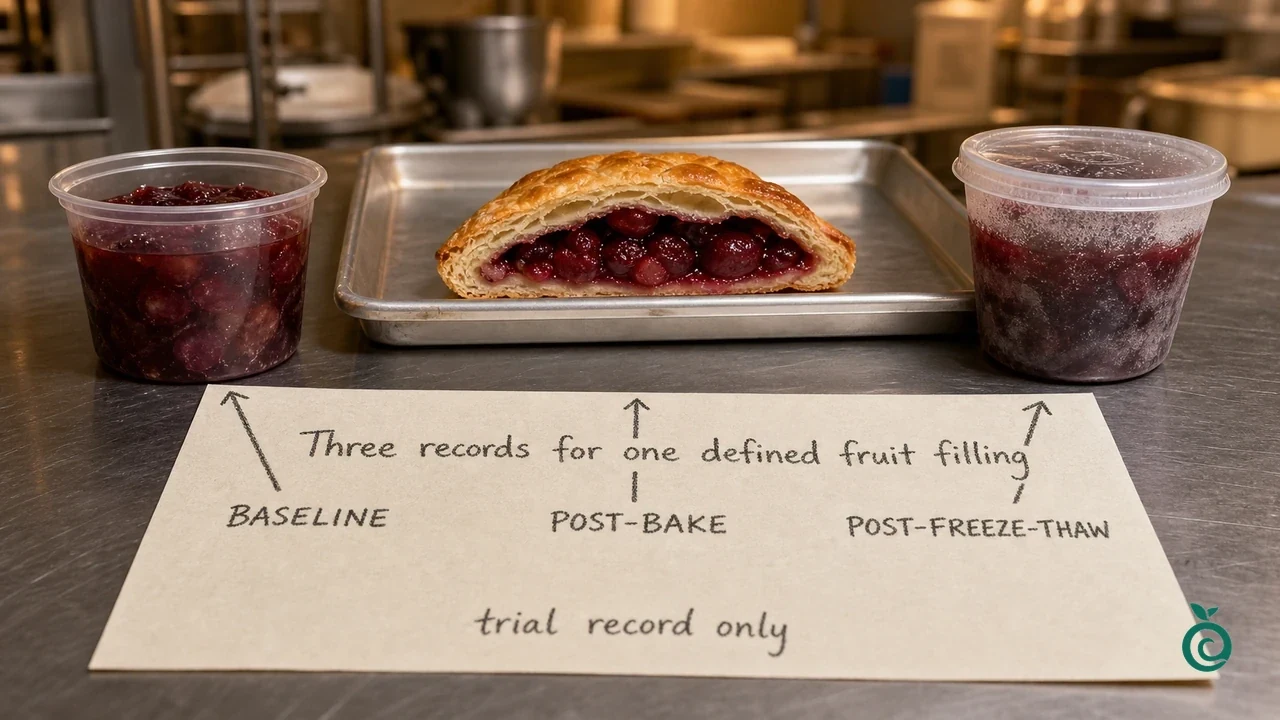
Three conditions need three records
Keep baseline, post-bake and post-freeze-thaw observations separate for the same defined fruit filling. The photograph illustrates the three records; the appearance of the samples does not establish a measured result. It is not a record of a factory trial or evidence of bake stability, freeze-thaw stability or shelf life.
Write one pass question before mixing
State the decision in one sentence: can this reduced-sugar jam meet the target sweetness and spreadability without unacceptable sourness, separation, aftertaste or storage change? Add the fruit, package, target market, intended use and current control. This keeps a tasting result from being mistaken for a full formulation decision.
Keep the sample routes comparable
A practical first round can include the current or sucrose control, a partial-reduction sample, a sweetness-only direction and a structure-adjusted direction. Keep fruit solids, process, acid timing, package and storage notes visible. If pectin, starch, calcium, fiber or a carrier changes, record it as part of the route rather than attributing the result to the sweetener alone.
Record the physical checkpoints with their methods
A number is useful only when the next operator can repeat the measurement. Keep the method, unit, sample preparation and actual temperature beside the value, and distinguish a numerical measurement from an observation. The following fields supplement the project's existing trial log; they do not prescribe limits for every jam.
- Instrument-maker guide: Brix measurement and reference basis
- Original sour-cherry study: measurement methods
- View stevia specifications
| Checkpoint | Keep with the result | Interpretation |
|---|---|---|
| Refractometer Brix | Instrument/reference basis, calibration check, sample preparation and temperature. | A mixed fruit formulation reading does not directly establish sugar content, sweetness or water activity. |
| pH and titratable acidity | Separate results; pH method and temperature; titration method, endpoint, acid equivalent and reporting basis. | Do not substitute pH for titratable acidity or use either alone as a taste score. |
| Viscosity or flow | Instrument/geometry or agreed flow method, speed or shear rate, temperature and sample history; value and unit. | Two viscosity values from different methods are not automatically comparable; spoon cling is a separate observation. |
| Set and spreadability | Cooling/setting time, serving temperature, portion and instrument or defined spreading procedure. | Judge the result against the intended spread, pouch, pump or finished use. Firmer is not automatically better. |
| Water activity and water release | Separate instrument water-activity result from visible separation; for measured release, record collection method, amount/unit and denominator. | No visible water is not a water-activity result or proof of microbiological safety. |
| Color and sensory balance | Actual light/serving conditions, sample codes and the same scoring anchors for sweetness, sourness, fruit flavor and finish. | Keep perceived taste and appearance distinct from solids, acidity and texture measurements. |
The instrument-maker Brix guide explains the measurement basis. In the 2021 sour-cherry study, refractometer soluble solids, chemical sugar analysis, texture and rheology were separate measurements under specified methods. That distinction is useful here; its formula or optimized response is not a specification for another fruit base.
Record the eating and use experience
Taste sweetness onset, fruit aroma, sourness, bitterness, lingering sweetness and mouth coating. Then check spoon cling, spreadability, visible fruit pieces, gloss, pastry or yogurt mixing and any water release. A jam that tastes balanced in a spoon test may still pump poorly, separate in a pouch or lose structure in a bakery process.
Repeat the score under the actual storage conditions
Agree the baseline and later checkpoints before making the samples. Choose them for the intended package, storage and use; a day number alone does not describe the condition. Record actual elapsed time, temperature, handling and whether the unit was unopened, opened or used for destructive testing. Use matched independent units where the next checkpoint requires an unopened pack. Recheck the selected physical and sensory fields using the same methods. Keep real time repeats and independent sample repeats identifiable rather than counting repeated readings from one jar as separate batches. Microbiological and shelf-life work belongs to the finished-product protocol; this quality scorecard does not replace it.
For a defined fruit filling, keep three observation records
A jam baseline cannot replace a record made after baking or after freeze-thaw for a defined fruit filling. Keep the baseline, post-bake and post-freeze-thaw entries separate; the three entries are trial records, not evidence of stability, no syneresis, shelf life, safety, a formula or an ingredient result.
| Condition | Record for the defined sample |
|---|---|
| Baseline | Identify the sample and note the project-defined observation fields before the added condition. |
| Post-bake | Record the same defined sample after the project's baking condition. |
| Post-freeze-thaw | Record the same defined sample after the project's freeze-thaw condition. |
Keep each condition tied to the same sample identity, actual treatment and project-defined observation method. A baseline result cannot stand in for a baking or freeze-thaw test, and a record without visible separation does not establish shelf life or safety.
Turn the score into the next brief
Identify which route answered the original question, which attribute improved and which trade-off remains. Record the actual control and candidate codes, formula or process change, method and checkpoint, then choose one question for the next trial. Agree the critical acceptance criteria before tasting rather than allowing a high average score to conceal a failure in a required attribute. Start the discussion with the fruit product, target market and the main problem you want to solve. Add the sample observations and conditions you already have; packaging, estimated quantity, documents and sample needs can follow when known.
What the research supports
Agudelo and colleagues studied a defined tapioca starch–pectin fruit-filling model under freezing and baking conditions. It supports evaluating the relevant treatment separately; it does not establish an ingredient choice, dose or pass limit for your filling. The sour-cherry paper is used here for its separation of methods and responses, without importing its proposed optimum or process endpoint.
Common questions
Which jam samples belong in a first-round comparison?
Keep the current or sucrose control, a partial-reduction sample, a sweetness-only direction and a structure-adjusted direction comparable.
Discuss this requestShould jam testing use Brix alone?
Use Brix alongside separate pH, acidity, texture, sensory and relevant water-activity measurements. In a mixed formulation, the refractometer reading does not directly determine sugar content or sweetness; keep its method and reference basis with the value.
Discuss this requestDoes day-0 approval prove a jam's shelf life?
No. A day-0 quality result only describes that sample and checkpoint. The intended storage conditions, package, physical and sensory changes, microbiology and finished-product protocol need their own review.
Discuss this requestCan this scorecard be used for erythritol-free jam projects?
Yes. Mark erythritol-free as a project constraint and record how the selected body, sweetness, finish, spreadability and storage route perform in the real fruit system.
Discuss this requestCan a jam baseline replace post-bake and post-freeze-thaw records for a defined fruit filling?
No. Keep baseline, post-bake and post-freeze-thaw records separate for the defined sample. Record actual treatment conditions and methods; none of these entries by itself establishes shelf life, safety or suitability for another formula.
Discuss this requestCan two viscosity results be compared if the numbers use the same unit?
Check the method as well: instrument geometry, speed or shear rate, temperature, preparation and sample history. Matching units alone does not make measurements from different conditions comparable.
Discuss this requestMust every result be complete before contacting Hengliyuan?
No. Start with the fruit product, market and the main issue. Send the control, sample observations and conditions you have; the remaining trial and purchasing details can be clarified during the discussion.
Discuss this request