
Read this guide in
MEAT SNACK SUGAR REDUCTION
Low-sugar jerky: why sweetness is not a water, color or chew test
A buyer guide for testing low-sugar jerky and meat snacks: separating sweetness, moisture, water activity, color, chewiness, oxidation and packaging.
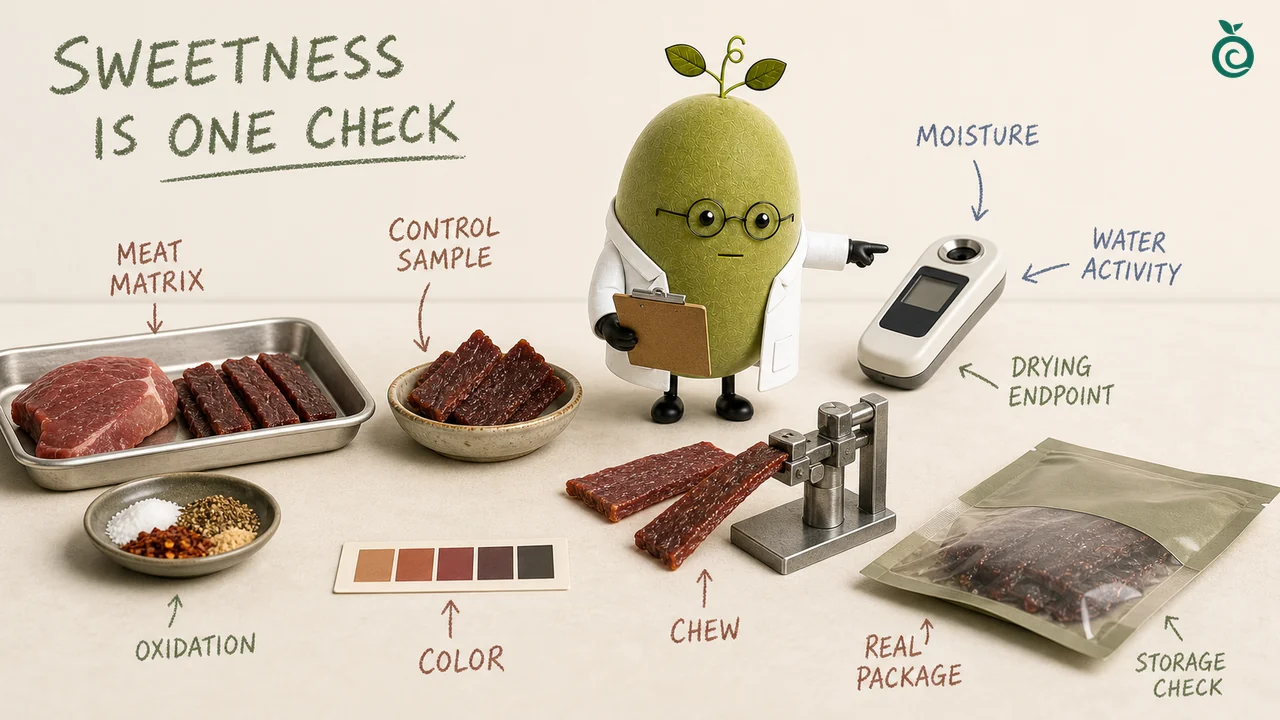
A low-sugar jerky sample can taste sweet enough and still be too dry, too hard, too pale, too dark or unstable in its package. The reason is that sweetness is only one output of a meat-snack process. Moisture, water activity, drying, color, texture, oxidation and packaging need their own checks.
This guide is for meat snack brands, jerky makers, seasoning developers and ingredient buyers. It turns the shared B2B question — why is the sweetness right but the product still not ready? — into a short, testable sample brief.
Start with first principles: sweetness is one job
Write down every role the current sugar, syrup or sweetener system plays: sweetness, marinade solids, surface color, flavor balance, water binding, tack, chew and the way salt or spices read after drying. Monk fruit and stevia can support sweetness, but they do not automatically replace those physical or process roles. Allulose or a polyol direction may add different functions, but the target market and finished product still decide whether the route fits.
Hold the process steady before judging the sweetener
A useful first screen keeps meat cut, thickness, marinade pick-up, salt and spice levels, drying route, endpoint and package constant. Compare the current control with a partial sugar-reduction sample and a sweetener-supported direction. If a texture or humectant direction is also being tested, keep it in a separate lane so the result is not credited to the sweetener alone.
Separate moisture, aw and food-safety validation
Moisture content tells you how much water is present; water activity (aw) describes how available that water is for reactions and microbial growth. They are related, but they are not the same measurement. A 2025 beef jerky study found that drying time changed aw, moisture and texture in its model, while the tested sugar levels did not significantly separate samples made at the same drying time. Do not turn that result into a universal threshold or a shelf-life decision. Drying, salt, pH, preservatives, packaging and microbiological process validation remain project-specific.
Record color and chew as separate outcomes
Check surface and cross-section color, then run the texture test separately. If instruments are available, record L*, a* and b* or the agreed color method; for texture, record shear force, hardness or a defined bite/chew protocol. The 2020 pork jerky study linked partial trehalose replacement with changes in color, moisture, hardness and chewiness under its own formulation and process. That supports a measurement plan, not a fixed replacement level for every meat snack.
Taste after drying and during storage
Evaluate the finished sample after marinating, drying and cooling, not only in the wet marinade. Record first sweetness, salt balance, spice and smoke notes, meat flavor, bitterness, licorice-like notes, lingering sweetness, chew and surface tack. Repeat the agreed checks in the actual package at defined storage points. A day-zero taste or a single aw reading does not prove commercial shelf life.
Keep claims and market access conservative
Low sugar, no added sugar, allulose, steviol glycosides, monk fruit ingredients, polyols and preservative statements are market- and product-specific. Confirm the launch country, nutrition data, ingredient names, required documents and finished-product safety validation before artwork or sales claims. The U.S. FSIS jerky guidance is a useful safety reference, but it does not approve a sweetener formula or replace the buyer's process validation.
Technical references
Reviewed August 2026 using the 2025 npj Science of Food beef jerky study (https://www.nature.com/articles/s41538-025-00433-8), the 2015 semi-dried jerky sugar-alcohol study (https://pmc.ncbi.nlm.nih.gov/articles/PMC4670891/), the 2020 pork jerky trehalose study (https://www.rlyj.net.cn/EN/Y2020/V34/I12/37) and USDA FSIS Jerky and Food Safety guidance (https://www.fsis.usda.gov/food-safety/safe-food-handling-and-preparation/meat/jerky). These sources support controlled variables and safety review boundaries; they do not prove a universal formula, shelf-life result, fixed aw limit or monk fruit, stevia or allulose dosage.
Review note
Reviewed October 2, 2026.
Common questions
Can monk fruit replace sugar in jerky?
It can support sweetness, but sugar may also affect marinade solids, color, moisture and eating quality. Compare a partial reduction against the current control after drying.
Is water activity the same as moisture content?
No. Moisture is the amount of water; aw describes how available that water is. Record both when they answer different formulation or process questions.
Does reduced sugar make jerky shelf stable?
No. Shelf stability depends on validated drying, aw, salt, pH, packaging, microbiological controls and the target market's requirements.
What should buyers send before meat snack samples?
Send target market, product type, packaging specification, estimated quantity, required certificates/documents and whether samples are needed, then add the meat, process and main test question.
