
Read this guide in
ERYTHRITOL-FREE TABLETOP SWEETENERS
Erythritol-Free Allulose Monk Fruit Tabletop Sweetener Guide
Erythritol-free tabletop sweeteners: compare 1:1 allulose-monk fruit blends, stick packets and private-label formats by market rules.
Erythritol-free tabletop sweetener projects often start with a simple question: can the product still pour, measure and taste familiar without erythritol?
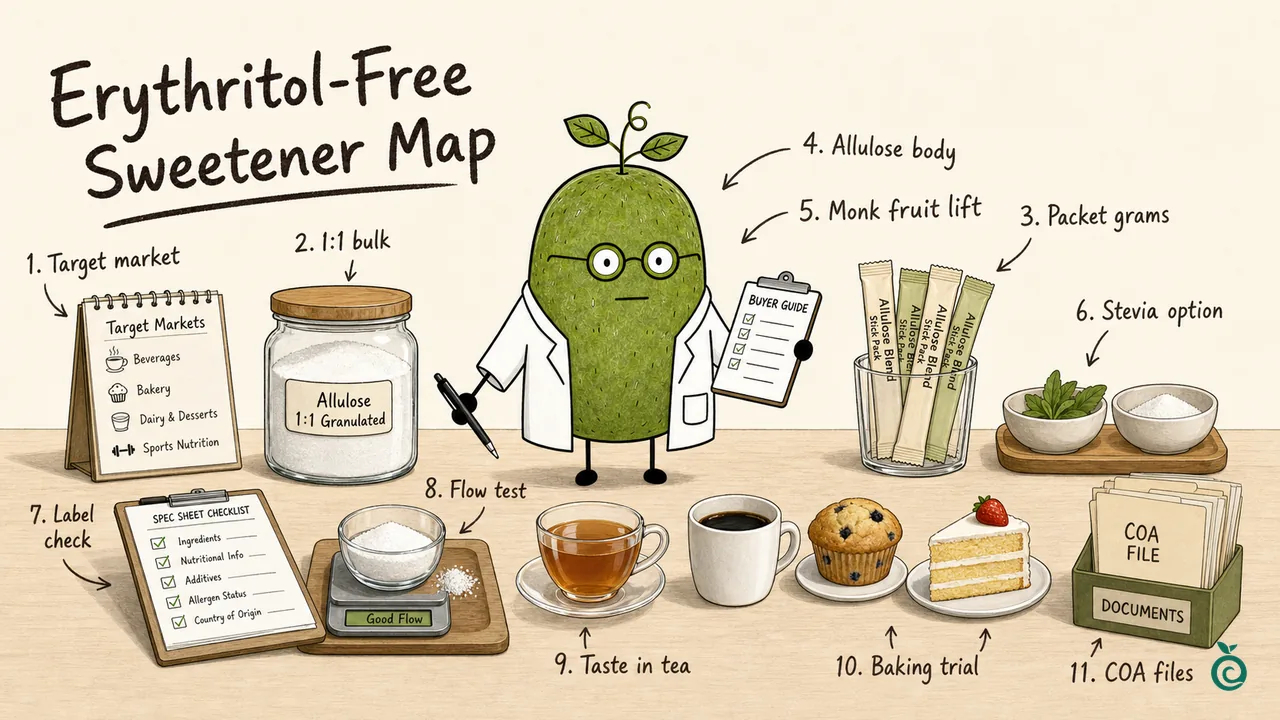
The answer depends on the format. A 1:1 spoonable jar, a stick packet, a high-potency sachet and a private-label pouch each need a different balance of allulose, monk fruit, stevia, carrier choice, serving size and label review.
Separate 1:1 bulk from high-potency use
A 1:1 granulated sweetener needs volume, flow and serving weight close enough for everyday use. A high-potency packet can be much smaller, but the buyer must explain how consumers will dose it in coffee, tea, yogurt, fruit, tabletop use or light baking. Do not approve both formats from one sweetener sample.
Decide what each ingredient is doing
Allulose can help body and a more sugar-like sweetness curve in markets where it fits the rule set. Monk fruit extract can add sweetness lift at low use levels. Stevia or specific steviol glycosides can also lift sweetness, but they may change bitterness, licorice-like notes or linger. The useful blend is the one that matches the application and label plan, not the one with the longest ingredient list.
Check the target market before label design
As of July 2026, US projects can use FDA allulose label guidance as a starting point for Nutrition and Supplement Facts treatment. EU projects need separate novel food review because EFSA's 2025 opinion on one D-allulose dossier concluded that safety could not be established from the submitted data. Australia and New Zealand projects should check FSANZ A1247 because that approval is tied to a specified enzymatic production route.
Test the real serving situation
Run small samples in hot tea, hot coffee, iced drinks, spoonable dairy or plant-based bases and any baking use that appears on the pack. Track sweetness onset, peak sweetness, lingering sweetness, bitterness, cooling effect, flow, dust, clumping, humidity pick-up, spoonability and packet fill behavior.
Prepare the private-label packaging brief
For jars, pouches, sachets and stick packets, share the target serving size, grams per packet, box count, retail pack weight, pouch barrier, carton plan, label language, shelf-life target and whether the product must avoid erythritol, sugar alcohols or other carriers.
Send a supplier-ready brief
Before requesting a quotation, send target market, product type, packaging specification, estimated quantity, required certificates/documents and whether samples are needed. Add desired sweetness equivalence, serving size, acceptable ingredient list and target use cases if they are already known.
Technical references
Reviewed July 2026. FDA's allulose guidance supports US nutrition-label treatment, not global approval. EFSA's 2025 D-allulose opinion and FSANZ A1247 show why market-by-market checks are needed. Public NOW Foods and Truvia allulose tabletop products are market-format signals for packets and allulose-plus-high-intensity blends; they do not prove Hengliyuan formula performance or regulatory fit.
Review note
Reviewed October 2, 2026.
How Hengliyuan makes the corresponding blend
Hengliyuan makes its allulose-based sweetener blends by high-speed powder mixing, which distributes the powdered ingredients in the selected formula. This is a common powder-mixing method. Confirm blend uniformity, particle size and application performance against the selected specification and sample.
Common questions
Can an erythritol-free sweetener still be 1:1?
It can be designed toward a 1:1 serving or volume direction, but the blend must be tested for bulk, flow, sweetness curve, aftertaste, label treatment and serving size.
Why not sell pure monk fruit powder only?
Pure monk fruit extract is high intensity and hard to dose for everyday tabletop use. Many buyer projects need bulk, packet weight and repeatable consumer instructions.
Can allulose, monk fruit and stevia be combined?
Yes, where the target market and label plan allow the ingredients. The blend should be tested in the real use case rather than approved from water tasting only.
What should buyers send before tabletop sweetener samples?
Start with your target market and product idea. Share any known packaging specification, estimated quantity, required certificates/documents and whether samples are needed; we can clarify the remaining details together.
