
Read this guide in
GRANOLA AND CEREAL GUIDE
Natural Sweetener Blends for Granola, Cereals and Clusters
Sweetener blends for granola and cereal clusters: monk fruit, stevia and allulose systems for binding, browning, crunch and shelf texture.
Granola, breakfast cereal and cluster products need sweetness, but sugar also helps binding, browning, crunch, aroma and flavor release. A reduced-sugar cereal project usually needs a complete sweetener system, not a one-ingredient swap.
This guide is for cereal brands, granola manufacturers, snack cluster developers, private-label buyers and ingredient teams comparing monk fruit, stevia, allulose, fibers or erythritol-free blend directions before sample testing.
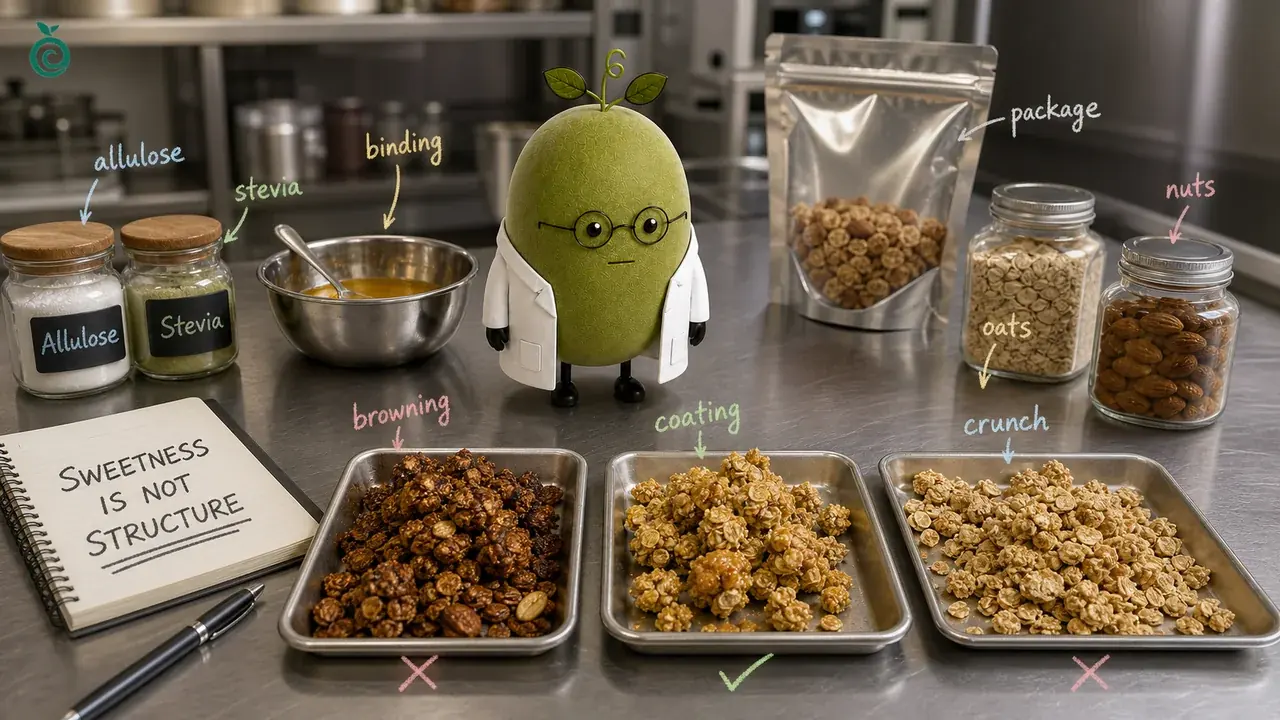
Sweetness and structure need separate evidence
Compare sweetness with cluster formation, browning, coating distribution and crunch in the actual cereal. The drawn trays, colors and tick/cross marks illustrate development questions, not tested formulas or an accepted sample ranking. The jars and finished pouch do not establish a particular ingredient dose, market permission or shelf life.
Start with the cereal format
A baked granola, nut cluster, coated cereal, extruded cereal, cereal bar and crunchy inclusion do not need the same sweetener plan. Share the format, process temperature, texture target and serving size before asking for a blend direction.
Separate sweetness from structure
Monk fruit and stevia can lift sweetness at low use levels, but they do not replace sugar's mass, binding or crunch by themselves. Keep a sweetness lane and a structure lane in the brief: the formula may still need allulose, fiber, syrup, protein, oil, starch or another binder depending on the product.
Browning and crunch need application tests
Allulose can be considered in markets where it is allowed when browning, toasted notes or cluster formation matter. Test oven temperature, bake time, cooling, breakage, stickiness and shelf texture because sugar-reduced clusters can darken or soften differently.
Dry blend behavior matters
For cereal coatings and dry inclusions, check particle size, dusting, clumping, coating uniformity and whether the sweetness stays even across the product. A sweetener that tastes balanced in water may not distribute evenly on oats, nuts or puffed grains.
Packaging affects shelf texture
Pouches, cartons, cups, single-serve sachets and bulk bags create different moisture and breakage risks. Share packaging specification and expected shelf life early so the sample direction matches the commercial package.
Compare the roles before choosing a blend
Keep the current product as the reference and identify each candidate material and formula version. A sweetness-only trial can show what still needs physical support; a structure-supported trial must record every binder, solids, water or process adjustment. These are development comparisons, not a requirement to release three formulas.
| Check | Keep in the comparison record | Decision it supports |
|---|---|---|
| Sweetness and finish | Actual addition, serving condition and coded reference | Does the candidate meet the taste target? |
| Binding and cluster yield | Binder identity and addition, mixing and cooling; agreed cluster/fines method | Is the intended cluster structure retained? |
| Browning and stickiness | Actual heating history, product appearance and handling observations | Is the process direction acceptable without hiding texture changes? |
| Coating distribution | Application method and observations across representative product portions | Does the intended product receive an even coating and taste? |
| Pack and storage texture | Package, seal, conditions and planned checkpoints; moisture and aw recorded separately | Which physical changes require the next trial? |
Set checkpoints for the actual product, package and intended life. Day 0/7/14/28 can be an initial screening example, not a universal validation schedule. Use the existing cereal crispness guide for the detailed storage record and separate opened-pack assessment.
Moisture and water activity are different measurements
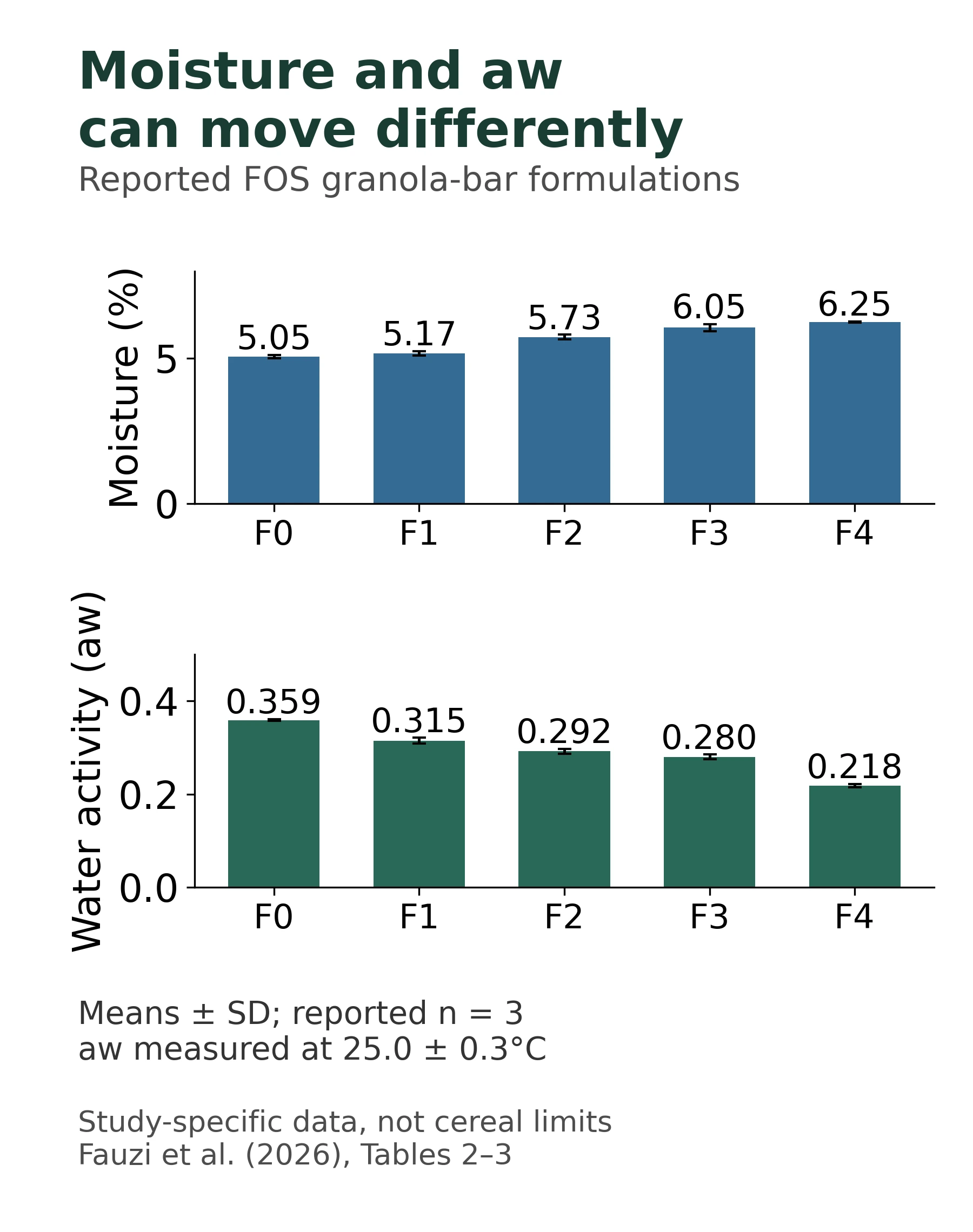
The 2026 FOS granola-bar study reported different directions for moisture and water activity across its five formulations. Read the paired measurements separately.
| Study code | Moisture, mean ± SD (%) | aw, mean ± SD |
|---|---|---|
| F0 | 5.05 ± 0.06 | 0.359 ± 0.002 |
| F1 | 5.17 ± 0.07 | 0.315 ± 0.006 |
| F2 | 5.73 ± 0.08 | 0.292 ± 0.005 |
| F3 | 6.05 ± 0.12 | 0.280 ± 0.005 |
| F4 | 6.25 ± 0.02 | 0.218 ± 0.004 |
Technical references
The puffed-cereal study and granola packaging research support checking moisture, fracture behavior and packaging conditions. Their material-specific observations are not universal cereal limits. The FOS study provides the separately identified example above; none of these sources establishes a Hengliyuan formulation, target-market permission or shelf-life promise.
Start with the cereal and the problem to resolve
Tell Hengliyuan the cereal format, final sales market and the sweetness, binding, coating or crunch issue. Add known ingredient restrictions, process and package information; if those are undecided, describe the intended product and reference. A final formula or order quantity is not needed to begin. After the sample direction is useful, connect the selected material and formula version to the specification, receiving pack, trial or repeat quantity, requested documents and delivery terms. This is a sweetener ingredient or blend discussion; specify a finished cereal request separately so supply fit is confirmed. Product safety, shelf life and finished-pack claims remain part of the complete cereal review.
Common questions
Can monk fruit or stevia replace the whole sugar function in granola?
They can supply sweetness, while bulk, binding, browning and crunch still need their own formulation and process checks. Identify the actual extract or blend and compare the complete cereal against the reference.
Discuss the cereal sample directionCan I choose a blend from the darkest or best-looking cluster?
Appearance is one observation. Keep color separate from binding, stickiness, breakage, first-bite crunch and storage response. Record the actual heating and cooling conditions so a visual preference does not hide an unresolved physical change.
Discuss the cereal sample directionDoes a higher moisture result always mean higher water activity?
No. Measure and record both where relevant to the product. The identified granola-bar research example shows why the measurements should stay separate; it does not supply your cereal target or a safety conclusion.
Discuss the cereal sample directionAre day 0/7/14/28 checks enough to claim shelf life?
They are an example screening schedule. Define the actual checkpoints and validation plan around the formula, process, package, distribution and intended life. A short physical or sensory comparison does not establish commercial shelf life.
Discuss the cereal sample directionCan we develop an erythritol-free direction?
State the exclusion and the cereal format. A candidate still needs to supply the required sweetness and physical functions, with its full composition and target-market fit reviewed. The exclusion itself does not establish sugar-free labeling or a successful formula.
Discuss the cereal sample directionWhat can I send if my formula and quantity are not final?
Begin with the cereal, final sales market and the problem or product target. Share known base, process, package and ingredient restrictions. The sample direction and subsequent specification and quotation details can be clarified from that starting point.
Discuss the cereal sample direction