Read this guide in
FILLED GUMMY SAMPLE BRIEF
Filled Gummies: Buyer Sample Brief for Shell, Center Flow & Seal Checks
Build a useful filled-gummy sample brief with separate shell, center, boundary and leakage observations. Use two practical tables to compare sweetener trials.
Review the shell, filling and assembled gummy separately. A shell that holds its shape does not tell you whether the center flows as intended, whether the boundary changes during storage or whether the closed product leaks.
For R&D and technical purchasing teams, the first useful brief identifies the current sample, one problem to solve and the conditions under which it appears. Use the two tables below to keep the sample request and the comparison record consistent.
Record the shell, center and closure separately
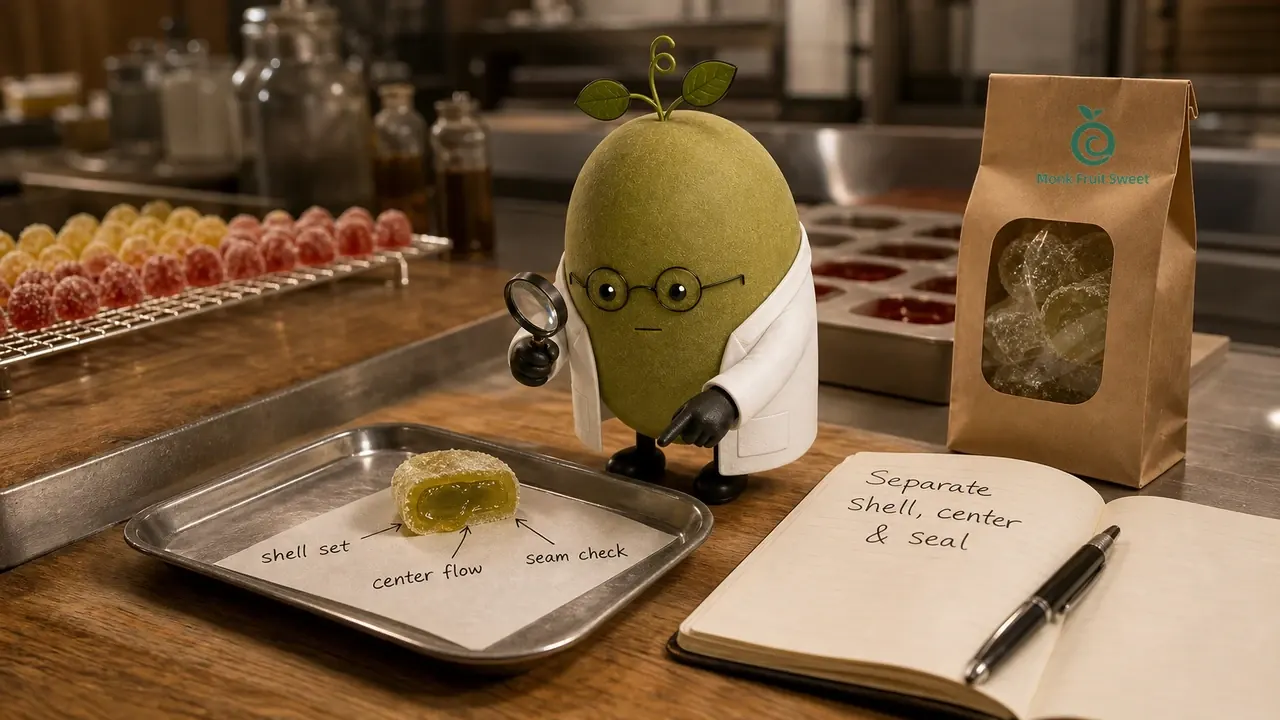
Describe the gelled shell and the liquid, semi-fluid or soft filling as two parts of the same product. Record the actual structure and filling route; do not infer them from the name “filled gummy.” If the design has a seam or closure, identify where it is inspected. Check an intact gummy for visible seepage before cutting it. Then inspect the cut surface and center using the same method across samples. Record whether filling was already outside the shell or appeared only after cutting: those observations answer different questions. Our recommendation is to keep shell set, center flow, boundary appearance and leakage as separate findings. If the shell looks acceptable but the center or closure has not been checked, leave those items unreviewed rather than assigning one overall pass.
Prepare a five-part sample brief
Start with the current formula or reference sample and one specific development question. You can begin a discussion with incomplete information; mark what is unknown instead of guessing the process or filling composition.
| Brief field | What to provide |
|---|---|
| Product and project | Finished format, sales market, current sample or comparator, and the one defect or improvement target |
| Shell | Gel or hydrocolloid route if known, formula version and the shell behavior to preserve or change |
| Center | Liquid, semi-fluid or soft filling; relevant ingredients; intended flow and observed behavior |
| Assembly | Documented filling route, shell–center arrangement and any seam or closure location |
| Observation and packaging | Time since manufacture, observation temperature, intact/cut condition, package and storage history |
A useful question is specific: for example, “visible seepage appeared on intact samples at the recorded observation time.” Keep the observation separate from a proposed cause. Include photos with the sample code and viewing conditions where available; a photo alone does not establish a leakage mechanism.
Use the same observation record for every sample
Compare each candidate with the current sample or an agreed control. Change one main variable where practical, and record any other change that was necessary. For a sweetener screen, identify which part of the product changed: shell, center or both. Use matched preparation, observation timing, temperature and package conditions. Record the number of units inspected and the number showing the stated defect; a single photo should not stand in for the whole sample set.
| Observation | Record consistently |
|---|---|
| Shell | Shape or set, cut-surface condition, sample age and whether inspected intact or cut |
| Center flow | Behavior at a defined temperature, cut method and observation time; measured viscosity only if a method is available |
| Shell–center boundary | Location and description of visible wetting, separation or other change, with matched photographs where useful |
| Closure and seepage | Inspection location, condition before cutting, units inspected and units showing the defined defect |
| Sweetness and flavor | Whole-product taste against the control; shell or center tasted separately if relevant to the question |
| Package and storage | Package type, storage conditions, elapsed time and the next planned observation |
Use the same defect definition across candidates. If no seepage is seen, record “none observed in the inspected units under these conditions,” together with the sample count and time. That gives the next trial a usable comparison without turning a short observation into a shelf-life claim.
Agree what the first trial can decide
Set the acceptance criteria for the specific development round before comparing samples. A first sweetener screen might select a direction for taste while leaving longer storage and production checks open. State which decisions are supported and what remains to be tested. A clean cut surface or an acceptable taste does not establish long-term leakage performance, shelf life, food safety or market compliance. Those decisions require the relevant product-specific formulation, process, packaging, storage and market reviews. Keep them linked to the final formula rather than treating an early sample as a release approval.
Read supporting research for the question it answers
McKenzie and Lee’s review of sugar reduction in confections discusses the difficulty of preserving texture and sweetness together. It supports considering more than sweetness when screening a reduced-sugar confection, but it does not supply a filled-gummy formula or establish leakage performance. The two tables here are Hengliyuan’s practical brief and observation structure. They do not prescribe a universal gel system, filling temperature, acceptance threshold or shelf-life test. Public patent disclosures and other suppliers’ product pages should likewise not be treated as operating settings for your product.
Test the sweetener in the filling and the assembled gummy
Screen the sweetener in the actual filling, then review the assembled gummy. A monk fruit extract supplies sweetness at a low dose; it does not automatically replace the mass or functions of the sugar removed. An allulose direction can also change the solids contribution, so define the complete replacement and confirm suitability for the intended market. Record the formula version, actual dose, preparation and filling conditions, dissolution and center-flow observation. Keep the shell system and package consistent for the first comparison where practical; record necessary changes instead of attributing every difference to the sweetener. For a sample discussion, send the target market, application, current sample or comparator, the part being changed and the observation you want to improve. The first discussion can start before every field is settled.
Review note
Reviewed October 16, 2026. The linked research supports the confectionery background; the tables organize project-specific observations. No leakage rate, storage life or formulation performance is claimed.
Record these fields before comparing filled-gummy samples
- Finished product and target market
- Current sample or agreed comparator
- Shell gel or hydrocolloid route
- Center type and observed flow behavior
- Shell-center boundary and seam observation point
- Package and storage context
- One defect question
- One main variable changed
Common questions
Does a set shell mean the filled gummy has passed?
No. Record shell set, center flow, boundary appearance and closure or seepage separately. An unchecked part remains open even when the shell looks acceptable.
Discuss filled-gummy samplesShould I inspect the gummy before or after cutting?
Record both conditions when relevant. Inspect the intact product first for visible seepage, then use a consistent cut method to examine the center and boundary. Filling released by cutting is not the same observation as seepage from an intact gummy.
Discuss filled-gummy samplesWhat should accompany a leakage photo?
Include the sample code, formula version, time since manufacture, temperature, package and storage history, and whether the gummy was intact or cut. Record the inspected sample count and the number showing the defined defect.
Discuss filled-gummy samplesCan one good sample establish shelf life?
No. It records a result at the stated observation point. Shelf life, production consistency and safety require the appropriate product-specific work with the final formula, process and package.
Discuss filled-gummy samplesCan I use patent examples as ready-made process settings?
Do not treat a public disclosure as validation for your own product. Define the actual formula, equipment and process, and agree the tests needed for the intended result.
Discuss filled-gummy samplesWhat if the formula or filling route is still undecided?
Start with the product concept, target market, current reference and one problem to solve. Mark unknown fields clearly. The brief can then guide which sample or information is needed next.
Discuss filled-gummy samples