Read this guide in
ALLULOSE SOURCING GUIDE
Allulose Sourcing Guide for 2026: Supplier, Specification & Planning Checklist
Compare bulk allulose offers by composition, pack size, assay basis and landed cost. Use real listing and document examples to check samples, COAs and delivery terms.
To buy bulk allulose, first identify whether the offer is pure allulose powder, syrup or a sweetener blend. Then compare the actual specification, net quantity, batch documents and delivery terms. A large pack or a low price per kilogram does not establish that two offers contain the same ingredient.
This guide helps food and beverage buyers compare offers before a sample becomes a purchase order. It includes real examples of pack sizes, blend composition and incomplete batch evidence, followed by checks for specifications, cost, storage and delivery. It does not list a universal Hengliyuan MOQ, stock level or lead time; those are confirmed for the specific material and request.
Start with the application and destination market. You can ask about allulose ingredients or samples before every purchasing detail is settled, then add the quantity, packaging, documents and required arrival date as the project becomes clearer.
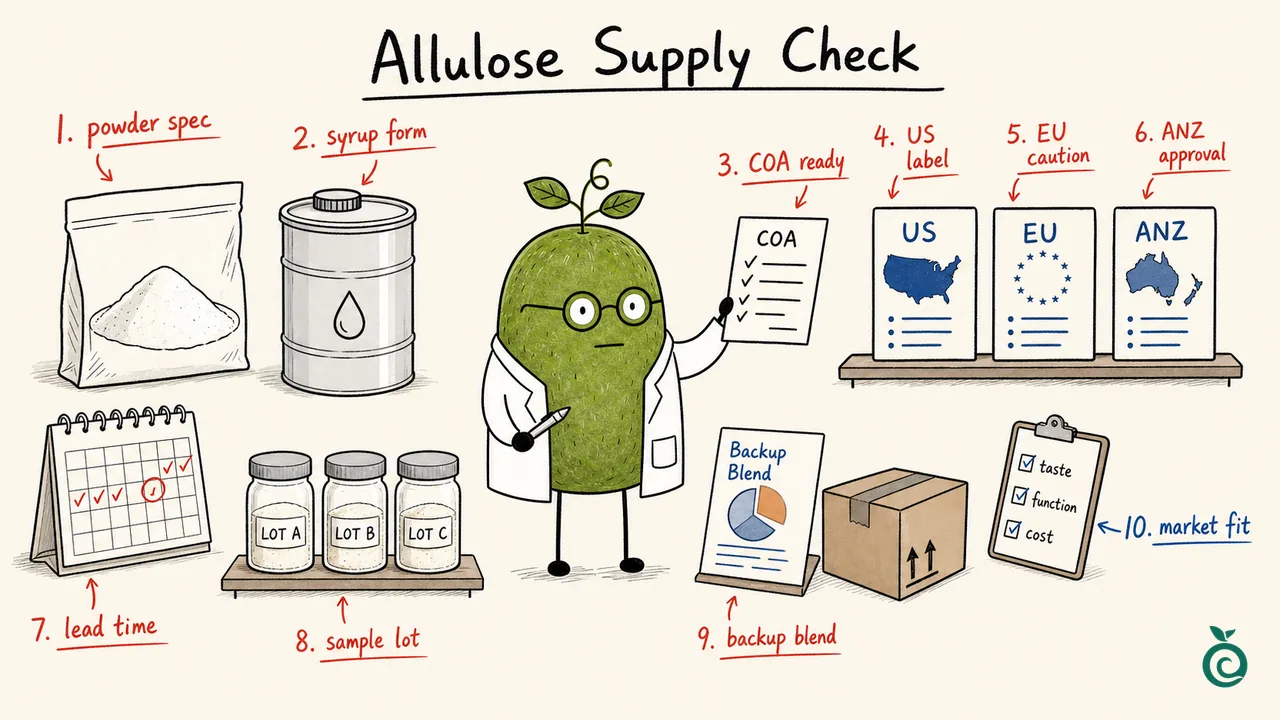
What does bulk allulose actually mean in an offer?
Bulk describes the commercial quantity or packaging; it does not identify purity, manufacturing source, certification or sweetness. A crystalline ingredient, liquid allulose and a spoonable allulose–monk fruit blend are different purchase objects. Read the full composition and specification before comparing them. The following examples were checked on October 22, 2026. They illustrate different offers, not a supplier ranking, a Hengliyuan quotation or a guarantee of current stock. Confirm the written net weight and contents of the actual order.
- Jedwards: allulose G1280 listing
- Sweet Logic: bulk allulose listing
- Lakanto: 20 kg allulose–monk fruit blend and ingredients
- Keystone Pantry: 18 lb allulose packaging description
| Public offer example | What the page identifies | Purchasing consequence |
|---|---|---|
| Jedwards G1280 allulose | 20 kg pack; the page describes allulose powder | Compare this ingredient offer with a matching material and specification, not merely another large bag. |
| Sweet Logic bulk allulose | 55 lb title and description; stated 55 lb MOQ and increments | 55 lb is about 24.95 kg. The URL still says 50lbs; use confirmed order documents rather than the URL to set net weight. |
| Lakanto Classic Monkfruit with Allulose | 20 kg pack; ingredients list allulose and monk fruit extract | This is a blended sweetener. Its sweetness and price cannot establish the assay or cost of pure allulose. |
| Keystone Pantry allulose | 18 lb box; two inner plastic bags inside cardboard | 18 lb is about 8.16 kg. Check net weight, inner packaging and resealing for your actual handling needs. |
Unit conversions use 1 lb = 0.45359237 kg and are rounded to two decimal places. These pack examples are not suggested Hengliyuan pack sizes. Ask separately about sample size, sales-unit size, minimum order value, MOQ and pallet configuration; they are different commercial terms.
Confirm the target market before volume planning
Do not start with a global assumption. The United States, European Union, Australia/New Zealand, Japan, South Korea and other markets can treat allulose differently. Ask the buyer's regulatory or label team to confirm whether allulose fits the target launch market before ordering volume.
Choose powder, syrup or blend by application
Powder may suit dry mixes, tabletop blends, bakery premixes and some confectionery trials. Syrup may fit beverage, sauce, dairy-style and bar work where water phase, texture or processing are important. A blend may be more useful when allulose needs support from monk fruit, stevia, fibers or carriers.
Build a specification comparison that the quality team can use
Ask for the current specification for the exact product code and manufacturing source being offered. Do not turn a competitor’s public limit, a brochure statement or a historical filing into the acceptance specification for another supplier. The quality team should agree the required limits, methods and reporting basis for your market and application.
| Item | What to record | Common mismatch to resolve |
|---|---|---|
| Identity and composition | Product code, form, full ingredients, manufacturer and manufacturing site | A blend described as pure allulose, or a distributor name mistaken for the factory. |
| Allulose assay | Result or limit, unit, dry/as-is basis and analytical method | A purity percentage without a basis, or syrup solids treated as allulose purity. |
| Other saccharides and water | Relevant sugar profile, moisture or dry solids, with method | Adding results from different samples or using °Brix as a complete sugar profile. |
| Physical properties | Appearance, particle-size method if needed, syrup handling information | Different sieve methods or a cold syrup viscosity omitted from a pumping trial. |
| Microbiology | Organism, result, limit, unit, test quantity and method as applicable | “Absent” without the sample quantity or a different unit between documents. |
| Elemental contaminants | Relevant analytes, units, limits and reporting/detection thresholds | Reading “<” as zero or comparing mg/kg with a differently scaled unit. |
| Claims and production documents | Origin, process, allergen/GMO statements and certification scope where requested | A certificate for another product, site or validity period. |
| Packaging and storage | Net mass, food-contact packaging, sealing, storage conditions, shelf/retest period | Shelf life without original-pack or temperature/humidity conditions. |
The specification defines acceptance requirements. A batch COA reports the identified lot against relevant requirements. An SDS addresses safety and handling; it does not replace the composition specification or batch analysis. Keep these documents linked, with their dates and versions visible.
Document case: do the reported results belong to the same batch?
EFSA’s June 2025 opinion on one D-allulose application shows why a high assay value is not a complete qualification package. In Table 2, the crystalline/powder records are split across Sub 1 and Sub 2. Some results are present for only one of them. The selected entries below retain that distinction.
| Selected Table 2 entry | Sub 1 | Sub 2 |
|---|---|---|
| Allulose purity, g/100 g | 99.85 | Not reported in the table |
| Loss on drying/moisture, % | Not reported in the table | 3.65 |
| Ash, % | Not reported in the table | 0.51 |
| Total plate count, CFU/g | <10 | <10 |
Do not combine Sub 1’s assay with Sub 2’s moisture and call the result a single verified batch composition. A blank or dash is missing information, not zero and not a passing result. The table identifies HPLC-RI for allulose and AOAC 935.29 for moisture; the reporting basis and method must still be understood before making a mass balance. EFSA reported that the requested compositional information for five independent batches had not been provided and considered the composition insufficiently characterized. The overall opinion also identified other unanswered requests and concluded that safety could not be established from the supplied dossier. This is a case about that application and its evidence gaps, not a finding about every supplier, a purchasing rule requiring every buyer to test five lots, or a Hengliyuan COA.
Ask for specification details early
Ask for the specification for the exact material being quoted, including its version and reporting basis. Review assay, moisture or syrup solids, relevant impurities, particle size where needed, microbiology, heavy metals, allergens, origin, process information and packaging with your quality team. A general brochure cannot replace the agreed specification or batch COA. Ask the seller to identify which company manufactures the ingredient, which company issues the specification and COA, and which entity is selling and shipping it. A distributor can be a suitable source, but the traceability chain should remain clear. Agree how a change of manufacturing source or specification will be notified and reviewed.
| Purchase stage | Confirm before moving on | Keep in the purchasing record |
|---|---|---|
| First inquiry | Market, application, material form and approximate quantity | Buyer brief; open questions clearly marked |
| Sample trial | Sample identity, specification version and intended use | Sample reference, batch identification and trial findings |
| Quote comparison | Same specification, quantity, pack size, currency and delivery basis | Dated quotation; freight, validity and exclusions |
| Order confirmation | Agreed specification, MOQ, quantity, timing and document requirements | Written order confirmation; estimated dates identified |
| Before dispatch | Commercial batch, agreed batch documents and shipping details | Batch COA and traceable shipment records |
Compare landed cost on a consistent material basis
Start with the same accepted composition, quality requirements and destination. Compare currency, quotation date and validity, net ordered quantity, packing, delivery term and named place. Separate freight, insurance, clearance, duty/tax responsibilities and local delivery, and avoid counting a charge twice when it is already included. Account for purchasing more than you need to meet a pack increment. For an ingredient comparison, a useful arithmetic check is cost divided by the quantity of allulose represented by the agreed reporting basis. If assay is stated on dry solids, estimated allulose mass = net material mass × dry-solids fraction × allulose fraction of dry solids. If assay is already on an as-received basis, do not apply the dry-solids factor again. For example, under hypothetical values of 1,000 kg net powder, 0.5% moisture and 99.0% allulose on dry solids: 1,000 × 0.995 × 0.990 = 985.05 kg calculated allulose. This illustrates the basis conversion only; it is not a Hengliyuan specification, measured shipment or recommended dose. Use actual agreed documents rather than these assumptions in a purchase calculation. For blends, compare cost at the accepted finished-product dose and any changes to bulk or processing. Normalizing a blend only to allulose mass does not value its high-intensity sweetener or prove equivalent performance. A cheaper kilogram is not necessarily a cheaper accepted formula.
Make the sample trial match the product you intend to buy
A supplier’s list of applications is a starting point for selecting a trial, not evidence that a specific grade will pass your process. Keep a control and record the candidate product code, lot, dose, preparation and measurement conditions. Agree acceptance criteria before tasting or processing.
| Application | Useful checks before a larger order | What to retain |
|---|---|---|
| Beverage, syrup or sauce | Mixing sequence, dissolution, solids, target sweetness and appearance after defined holding | Preparation temperature, concentration and observation times. |
| Biscuit, cake or bakery premix | Dough handling, browning, final moisture/texture and storage behavior | Formula, bake profile, cooled and stored comparisons against the control. |
| Frozen dessert | Solids balance, scoopability, melt behavior and temperature-abuse response | Freezing conditions, storage temperatures and agreed observation intervals. |
| Dry mix or tabletop blend | Mixing uniformity, flow, filling and portion consistency | Blend version, packaging settings and samples from multiple locations/portions. |
If the approved sample is from a different batch, site, product form or specification version than the commercial material, document the difference and decide which checks must be repeated. Do not infer a universal shelf life or a validated manufacturing process from one short sample trial.
Treat supply timing as part of formulation
Work backwards from the date the ingredient must reach your production site. Separate sample preparation, sample approval, production or allocation, dispatch, transit and customs clearance. Ask what starts the quoted lead time: order confirmation, payment, specification approval or another agreed condition. Record an estimated dispatch date separately from a confirmed one. A sample shipment is not evidence that commercial stock is reserved. Also confirm whether the quote refers to a full pack, pallet or partial shipment, and which document approvals can delay release. A website stock indicator or another supplier’s processing time is not a reservation or an arrival commitment for your order.
MOQ, pack size, availability and lead time need confirmation for the selected material and order. Do not use a generic website figure as the promise for a time-critical launch.
Agree COA timing and receiving checks before placing the order
Document availability has a timetable. For example, the Jedwards G1280 page says lot-specific COAs are attached to the shipment notification email sent the morning after shipment. That is its stated document workflow, not a universal industry rule. If your quality system requires COA review before dispatch, ask whether that can be arranged and put the agreed timing in the order. At receipt, compare the purchase order, delivery record, product and lot labels, net quantity, packaging condition and COA against the accepted specification. Check manufacture and expiry/retest information and investigate broken seals, moisture exposure, caking or an unexpected product/source code through your quality procedure before releasing material to production. A shelf-life statement needs its conditions: original unopened packaging, storage temperature/humidity where specified, and the applicable product version. An instruction to reseal or use an airtight bin, such as the one on Keystone Pantry’s listing, addresses handling; it is not proof that the material remains acceptable after any period of opened storage.
Match certification claims to the actual allulose material
If organic, non-GMO, kosher, halal or another claim is required, request the applicable document and review the product, manufacturing/handling site, issuing body, validity and scope. A logo on a category page does not establish the certification status of every grade. A certificate for stevia or a different sweetener does not certify allulose. Record the document requirement before comparing quotations. If a claim or a supply route cannot be verified for the offered material, keep it unresolved rather than substituting another product’s certificate. Product and destination-market review remain separate from the general availability of a certificate.
Plan a fallback if allulose is not suitable
A second source and a replacement formula solve different problems. If timing is the issue, qualify another source against the agreed specification. If allulose does not fit the destination market or product brief, changing the sweetener system requires formulation and label review. Decide which route you need before calling either one a backup.
| Backup route | What changes | What to check |
|---|---|---|
| Another source of allulose | Supplier, manufacturing source or batch | Specification, process and origin documents; application performance |
| Powder instead of syrup, or syrup instead of powder | Solids, water contribution and handling | Recalculate the recipe and repeat affected process checks |
| A different sweetener system | Ingredient composition and functional roles | Taste, bulk, texture, label and destination-market suitability |
Connect the sample, specification and commercial batch
Keep a purchasing record with separate fields for the material form, sample reference, specification version, sample batch and proposed commercial batch. Ask whether the sample is representative of the material that would be supplied, and record any differences the supplier identifies. Review the specification with the quality team before accepting the quotation. For each relevant COA entry, distinguish a reported result from a limit or a statement of compliance, and check the reporting basis. Do not assume the sample and the eventual order share a batch number. Before shipment, confirm which batch documents will accompany the order and how they relate to the agreed specification. If a specification or product form changes after the trial, decide which application checks need repeating. This keeps an accepted sample from becoming an undocumented substitute for the actual order specification.
Ask for a sample or a comparable quotation
Send the destination market, product application and preferred form if known. Add your estimated order quantity, packaging needs, documents and required arrival date when available. Mark unknown items as undecided. We can review the material and document options with you before the purchasing brief is complete; price, availability and supply timing are confirmed for the specific request. For a comparable response, ask the supplier to return the exact product/form and composition, proposed specification version, sample identity, net pack size and MOQ, manufacturing source, dated delivery basis and validity, lead-time start condition, and the document list with its availability dates. Mark pending items explicitly; a blank should not become an assumed promise.
Official source notes
FDA's October 2020 guidance addresses U.S. nutrition labeling and calorie calculation; it is not an approval of every allulose product. EFSA's June 2025 opinion concluded that safety could not be established from the submitted dossier after requested information was not supplied. FSANZ's A1247 approval and Amendment No. 233 concern D-allulose subject to the specified production method and conditions. Check whether the actual material and intended use meet the destination rules before committing to a bulk purchase. The 2025 EFSA opinion concerns the submitted application; it is not itself a complete statement of every current market authorization. Review the current applicable register and the actual production source with the buyer’s regulatory team. U.S. labeling guidance does not make every allulose-containing finished food eligible for a sugar or calorie claim.
Review note
Reviewed October 22, 2026. Public listing examples describe the pages observed on that date, not verified supplier stock or Hengliyuan commercial terms. The EFSA document case retains the June 2025 opinion’s application-specific scope and missing-data limitations. The cost example uses explicit hypothetical assumptions. Confirm the actual material, market rules and order documents before purchase.
Common questions
Can I compare allulose quotes by price per kilogram?
Only after matching the material form, specification, quantity, packaging and delivery basis. For syrup, compare solids and assay on their stated basis rather than treating a kilogram of syrup as a kilogram of powder. Check freight, currency, quotation validity and exclusions as well.
Discuss allulose samples and sourcingWhat is the MOQ or lead time for allulose?
These must be confirmed for the selected material, pack size and order. Ask when the lead-time clock starts and whether the date refers to dispatch or arrival. Keep estimates separate from confirmed commitments.
Discuss allulose samples and sourcingDoes a successful sample trial confirm the commercial batch?
No. Record the sample reference and specification, then confirm which batch will supply the order and which documents will accompany it. Review any differences and repeat affected checks where needed.
Discuss allulose samples and sourcingIs a second allulose supplier the same as a backup formula?
No. Another source needs supplier and material qualification. Replacing allulose with a different sweetener system can change sweetness, bulk, texture and labeling, so it requires a separate formulation review.
Discuss allulose samples and sourcingIs allulose allowed in every destination market?
No universal permission applies. Check the current rules for the destination, actual production source and intended use. A labeling guidance or one specific approval does not establish that every allulose material can be sold everywhere.
Discuss allulose samples and sourcingCan I ask about samples before I know the order quantity?
Yes. Start with the application and destination market. Share any known material preference, approximate quantity, document needs or timing, and leave undecided details open for discussion.
Discuss allulose samples and sourcingIs bulk allulose always pure allulose?
No. Bulk offers can include crystalline allulose, syrup or allulose-containing blends. Read the full ingredient list, product code, material form and assay basis. A 20 kg allulose–monk fruit blend is not equivalent to 20 kg of pure allulose.
Discuss allulose samples and sourcingCan I accept a COA with missing values or results from different lots?
Keep each result tied to its identified lot, method, unit and reporting basis. Missing values are not zero or a passing result, and a value from another lot does not fill a gap in the proposed batch. Resolve the required evidence with your quality team before release.
Discuss allulose samples and sourcingDoes an organic certificate for another sweetener cover allulose?
No. Check the applicable product, site, certificate scope and validity. A document for stevia or another ingredient does not establish organic status for the allulose material being quoted.
Discuss allulose samples and sourcing