SWEETENER COMPARISON
Sucralose vs. Erythritol: Sweetness, Taste, Uses and Safety
Compare sucralose and erythritol by sweetness, dose, cooling sensation, calories, digestive tolerance and the limits of current safety research.
Sucralose is a high-intensity sweetener used in very small amounts. Erythritol is a sugar alcohol used in much larger amounts, often to provide both sweetness and bulk. They are different ingredients and may appear together in one sweetener blend.
The practical choice depends on the food, the desired taste and the amount consumed. This comparison explains why they cannot be exchanged gram for gram, what to check on a label, and why recent health studies do not establish a simple “safer sweetener” ranking.
The main differences at a glance
Reference sweetness values describe ingredients, not every commercial preparation or recipe. Erythritol sweetness is commonly reported as roughly 60–80% of sucrose; the result varies with concentration and sensory conditions.
- FDA: reference sweetness of sucralose
- Hong Kong Centre for Food Safety: polyol properties and sweetness
- EFSA: erythritol identity and production
| Comparison | Sucralose | Erythritol |
|---|---|---|
| Ingredient family | Artificial high-intensity sweetener; E955 | Sugar alcohol (polyol); E968 |
| Reference sweetness versus sucrose | About 600 times | About 0.6–0.8 times |
| Typical formulation role | Provides intense sweetness at a low dose | Adds material as well as some sweetness |
| Taste consideration | Assess the finish in the intended food | Cooling sensation can be noticeable, especially as crystals dissolve |
| Amount used | Pure ingredient often measured in milligrams for small batches | Often measured in grams; total intake matters |
| Prepared blends | Check for carriers and other sweeteners | May be blended with sucralose, stevia or other sweeteners |
Calories and carbohydrates: distinguish the ingredient from the label
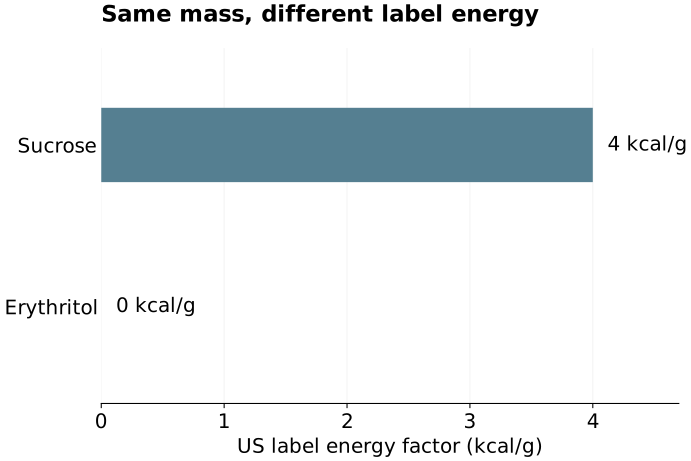
Pure sucralose is non-nutritive. For US nutrition labelling, 21 CFR 101.9 assigns erythritol an energy factor of 0 kcal/g. This does not mean every sugar alcohol has that factor, or that an erythritol-containing food has no calories. Erythritol is a polyol, so “sugar alcohol” and “sugars” are different label concepts. Other ingredients in a packet, powder or finished food may supply digestible carbohydrate and energy. Compare the complete product, the declared serving and the rules of the country where it will be sold. A “net carbs” calculation or a keto claim is not a substitute for this review.
- US energy factors and carbohydrate declarations
- EFSA: sucralose as a non-nutritive sweetener
- US nutrition label calculator
Can erythritol replace sucralose gram for gram?
No. Using reference sweetness alone, 10 g of sugar would correspond to approximately 12.5–16.7 g of pure erythritol, compared with about 16.7 mg of pure sucralose. These are arithmetic illustrations, not recommended doses, tested recipes or legal use levels. Increasing erythritol to match sweetness also increases the amount consumed. Increasing a retail sucralose product changes the amount of its carriers too. Read the preparation’s composition before using either calculation. For formulation work, set the target sweetness first, then evaluate bulk, flavour, serving intake and cost in the complete product. A blend can combine erythritol’s mass with a small amount of sucralose for sweetness; the chosen ratio still requires a product-specific trial.
Cooling, aftertaste and the food itself
Erythritol can produce a cooling sensation as it dissolves. That may suit some mint or refreshing products, while being less welcome in others. It is a sensory property, not evidence that the product is healthier. Compare samples at matched perceived sweetness and their intended serving temperature. Record cooling, sweetness onset, the finish and any visible crystals after storage. Sucralose is not automatically free of aftertaste, and erythritol is not automatically indistinguishable from sugar. The flavour base and preparation matter. Hengliyuan’s ready-to-drink guide describes a condensed-milk-like taste observed when an erythritol, Reb M and sucralose blend was added to milk. That is a specific flavour observation, not evidence that these two ingredients alone reproduce condensed milk or have the same nutrition.
Digestive tolerance and blood glucose
EFSA’s 2023 erythritol review set an acceptable daily intake of 0.5 g/kg body weight/day, based on protection against diarrhoea and related effects. This is a regulatory assessment value, not a suggested serving or a guarantee of individual tolerance. Count erythritol from all foods consumed, not one packet in isolation. The same review found limited but consistent human evidence of no effect on blood sugar, while noting the absence of long-term studies. That conclusion concerns erythritol, not every food containing it. Sucralose research has also reported protocol-dependent metabolic findings; zero sugar does not prove the absence of all biological effects. For someone managing diabetes or persistent digestive symptoms, choosing between these ingredients should be considered with the complete diet and clinical advice.
Erythritol and cardiovascular studies: what is known?
The evidence deserves attention, but it does not establish a direct safety ranking against sucralose. Blood concentrations, short-term platelet responses and actual cardiovascular events are different outcomes. The studies below must be read at those separate levels.
- 2023 observational and mechanistic research
- 2024 human erythritol/glucose intervention
- 2026 crossover study: preprint, not peer reviewed
| Evidence | Reported finding | Important limitation |
|---|---|---|
| 2023 observational cohorts | Higher circulating erythritol was associated with subsequent cardiovascular events. | Blood levels do not distinguish dietary intake from erythritol made within the body; association alone does not prove dietary causation. |
| 2024 intervention, 10 people per group | After 30 g erythritol, platelet responsiveness increased; this was not seen with the glucose comparator. | Small, acute study; it measured platelet responses, not heart attacks or stroke rates. It did not compare sucralose. |
| September 2026 preprint, 14 analysed participants | A randomised crossover protocol using 50 g erythritol reported no increase in platelet aggregation compared with water. | Not peer reviewed; small, acute study with different methods and comparator. It does not establish long-term safety or erase the earlier finding. |
Does natural origin or WHO guidance settle the choice?
No. Erythritol occurs naturally in some foods and commercial material is produced through fermentation. Sucralose is manufactured by modifying sucrose. Those origins describe how the ingredients arise; they do not prove which finished food or intake is safer. WHO’s 2023 non-sugar-sweetener recommendation includes sucralose but excludes sugar alcohols such as erythritol. That scope difference is not a WHO endorsement of erythritol for weight loss. Likewise, a food-additive assessment is not evidence that choosing a sweetener will prevent disease.
Which should you trial in your product?
When only a small sweetness adjustment is needed and the recipe already has sufficient solids, a high-intensity ingredient may be a practical trial option. When replacing a substantial mass of sugar, consider how to replace its physical functions; erythritol or a blend may supply some of that mass, with cooling and intake assessed separately. For heating, do not extend one ingredient’s stability statement to a blend containing sucralose. Review the actual process and the sucralose-specific heating evidence. Taste tests cannot detect every possible degradation product. For a Hengliyuan sample brief, specify the application, target market, serving size, current sugar level and preferred ingredient declaration. Compare the actual candidates before selecting a formula or making a claim.
Common questions
Is erythritol the same as sucralose?
No. Erythritol is a sugar alcohol; sucralose is a high-intensity sweetener. They can be used together in a blend.
Which is sweeter: erythritol or sucralose?
Pure sucralose is far more intensely sweet. Reference values are about 600 times sucrose for sucralose and about 60–80% of sucrose for erythritol; preparations and sensory conditions change the practical comparison.
Can they be used together?
Yes, a blend can use erythritol for bulk and sucralose for additional sweetness. This does not establish a universal ratio, permitted use or health advantage.
Is erythritol safer than sucralose?
The sources reviewed here do not establish a direct overall safety ranking. Consider the actual intake, relevant regulatory conditions and the limitations of each study.
Does a zero-calorie label mean unlimited intake is suitable?
No. Calorie labelling does not establish digestive tolerance, a recommended serving or long-term health effects.